
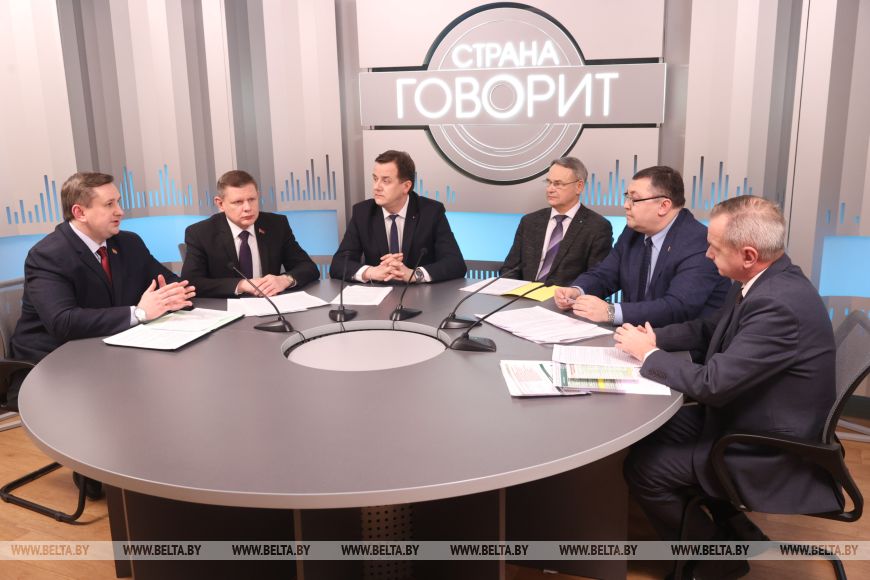
MINSK, 24 January (BelTA) – Academician-Secretary of the Department of Chemistry and Earth Sciences at the National Academy of Sciences of Belarus (NASB) Aleksei Trukhanov outlined the key developments of NASB in 2025 in a new episode of BelTA’s Nation Speaks project.
Throughout 2025, the National Academy of Sciences worked in seven key areas aligned with its structure, covering a wide spectrum of developments for the priority tasks of the concluded five-year plan, he emphasized. “A number of significant results were recognized with NASB awards. For instance, an interdisciplinary series of works on creating bone-replacing biomaterials received an award. This is not just a development of an academic institute but a project that has already undergone testing in institutions of the Ministry of Healthcare,” Aleksei Trukhanov said.
The development of a national monitoring system for plant life and natural ecosystems was also recognized. This work by the Institute of Experimental Botany was completed in 2025 after decades of effort, he noted.
The work of young researchers was honored with the Zhores Alferov prize for analyzing energy emission mechanisms in compact astrophysical objects and developing new functional magnetic materials for electronic devices, the scientist continued. The Vasily Kuprevich prizes were awarded for work in human physiology, synthetic biology, experimental botany, and new methods for processing food components.
According to Aleksei Trukhanov, the results of young scientists at the NASB have transcended academic boundaries. “In 2025, two out of three Union State of Belarus and Russia awards in science and technology for young scientists went to teams of the Academy. These are the team from the Scientific-Practical Materials Research Centre and their development of functional materials for sensor applications and the team from the Institute of Bioorganic Chemistry and their protein analysis for new approaches in diagnosing and treating diseases. The work was conducted in close cooperation with Russian colleagues. This highlights the potential of our young scientists and the strong relations with Russia. The results from the Institute of Bioorganic Chemistry laid the groundwork for a new Union State program for this five-year period, including research on personalized medicine,” the scientist explained.
There is also a trend towards interdisciplinary cooperation, especially with the Ministry of Healthcare. In the Top-10 competition for NASB scientists’ achievements, awards were given for a wide range of results from fundamental research. Aleksei Trukhanov highlighted the development and market launch of the import-substituting drug produced by the Akademfarm enterprise.
“It is difficult to single out one specific development for 2025. The research covers all priority areas, from Antarctica to space,” he concluded.