

Every one of us has encountered white stains on winter shoes at least once in our lives. Every year, road maintenance service actively spread technical salt on sidewalks and roadways to reduce accidents and injuries on slippery roads. This salt, however, settles on our footwear, penetrates the material, and leaves its mark. How harmless is this method of combating icy conditions? How can we preserve the original look of our footwear in winter? What should we do if that unfortunate residue still appears on them? Find the answers in the Deep Dive project.
Shoes of millions
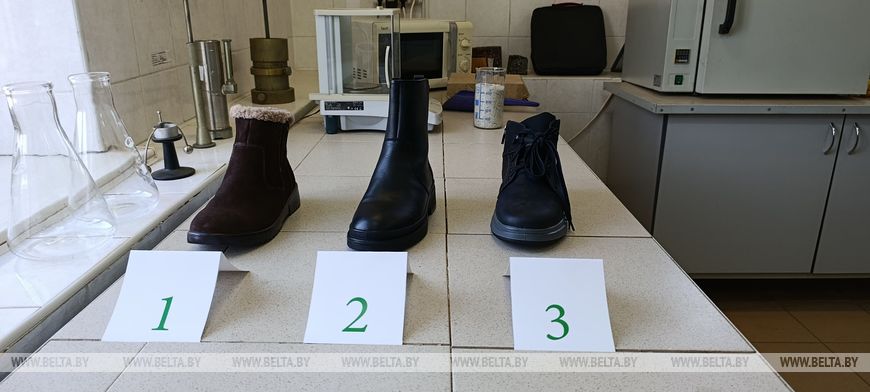
For our experiment, we have three pairs of regular winter shoes made by one of Belarus's leading manufacturers. The first is a pair of brown velour boots used by a mother. The second is a pair of black leather boots for a teenage son. The third is a pair of boots made from natural leather in a combination of materials. That’s what the manufacturer claims, and we believe them.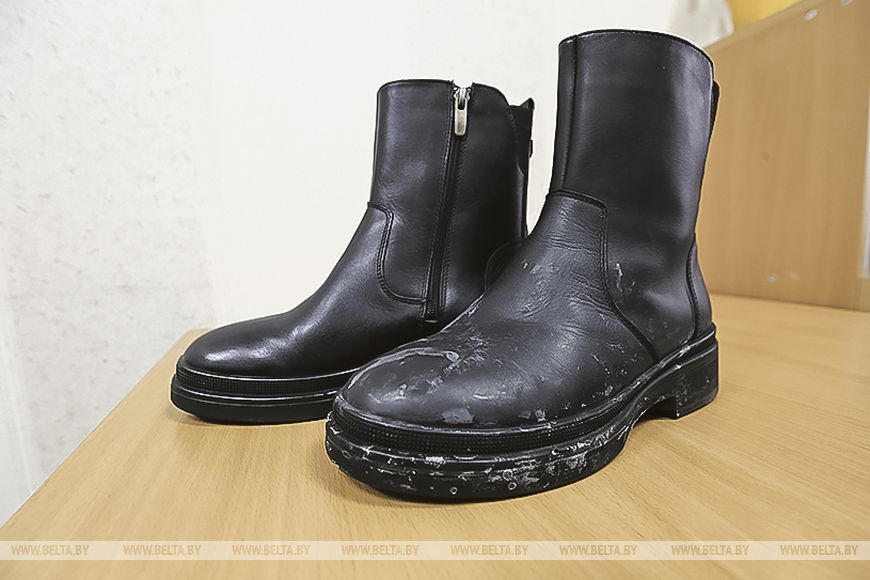
All the shoes are straight from the store. It seems the family just went shopping for new items the day before. The mother (we performed this step for her) thoroughly sprayed her pair with a water-repellent treatment. At the same time, the woman (again, journalists stepped in for her) polished her son’s boots generously with black shoe polish. As for the dad, he turned out to be a busy man and didn’t treat his boots at all - he just slipped them on in the morning and rushed off to work. But let's not forget - the manufacturer itself treats new shoes during production.
Shoes of millions
For our experiment, we have three pairs of regular winter shoes made by one of Belarus's leading manufacturers. The first is a pair of brown velour boots used by a mother. The second is a pair of black leather boots for a teenage son. The third is a pair of boots made from natural leather in a combination of materials. That’s what the manufacturer claims, and we believe them.
All the shoes are straight from the store. It seems the family just went shopping for new items the day before. The mother (we performed this step for her) thoroughly sprayed her pair with a water-repellent treatment. At the same time, the woman (again, journalists stepped in for her) polished her son’s boots generously with black shoe polish. As for the dad, he turned out to be a busy man and didn’t treat his boots at all - he just slipped them on in the morning and rushed off to work. But let's not forget - the manufacturer itself treats new shoes during production.
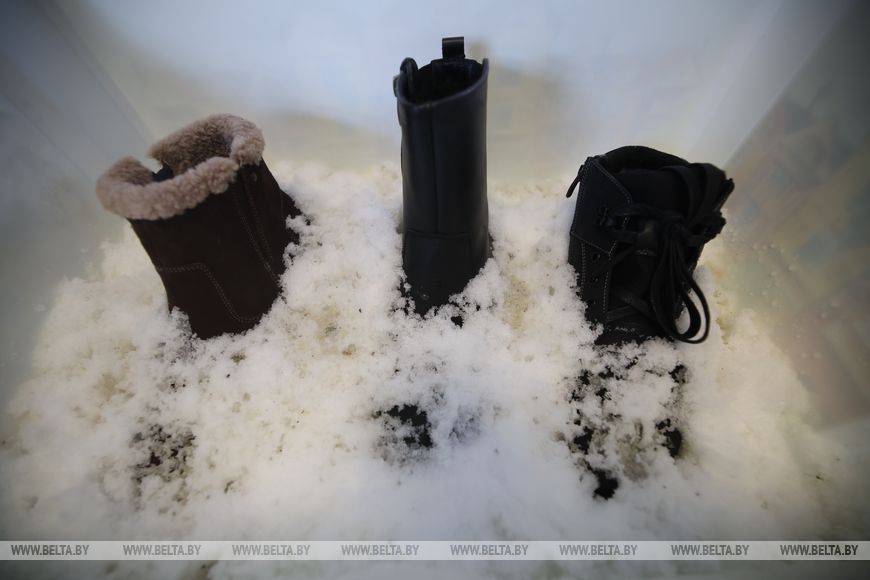
For our experiment, we take a large plastic container and fill it with a cocktail of snow and salt - the same salt used by the State Production Association Gorremavtodor of the Minsk City Executive Committee for treating streets. We bury one shoe from each pair in this volatile mixture and place the container in a warm location for an hour. After all, most Belarusians spend about an hour commuting to work, and wet boots are often dried on a radiator.
Cheap and salty
A week after the Ulli snowstorm struck Belarus, the State Production Association Gorremavtodor of the Minsk City Executive Committee resembles more of a military unit during an operation. Snowplows and salt spreaders are constantly leaving through the gates. The latter soon return for fresh batches of de-icing agent.
Over the week, our company has removed more than 480,000 cubic meters of snow, said Ruslan Yasyuchenya, head of the Tsentr department at Gorremavtodor. “Regarding salt, contrary to popular belief, we begin treating roadways with mixtures not after clearing the snow, but before precipitation occurs. Regulatory documents specify that when temperatures are forecast to drop, even without precipitation, preventive treatment of road surfaces and pedestrian zones must be conducted.

According to him, such preventive measures began as early as November when temperatures began approaching zero. The only difference from the winter period is the reduced dosage.
This preventive measure helps avoid the formation of ice and icy conditions. Consequently, it reduces the number of traffic accidents and injuries due to slippery surfaces. Since November, approximately 55,000 tonnes of salt and about 19,500 tonnes of salt & grit mixtures have been spread on the streets of Minsk, Ruslan Yasyuchenya said.
According to regulatory and technical documents, different types of mixtures are used at various below-zero temperature levels, and the amount of salt spread is standardized in grams per square meter. The lower the air temperature and the heavier the precipitation, the higher the rate of salt application is. For example, at -20°C, the amount is approximately 40–45 grams per square meter. In simple terms, this is a pinch of salt whose chemical formula – NaCl - is the same as that of table salt.
Its use in Belarus is regulated by internal technical documents. The de-icing agents used by Gorremavtodor comply with standards, Ruslan Yasyuchenya emphasizes. “There are two types: ‘Technical Salt’ and ‘Salt & Grit Mixture’, the latter containing the same technical salt in varying concentrations. The composition of the mixture has not changed in recent years. We source the raw materials from Belaruskali. Today, salt is an effective measure, and considering it is home-made, it is also relatively inexpensive.
So, a tonne of the material costs just under Br40. As for other countries, they also use this de-icing agent, only it is much more expensive.
“Treating road surfaces reduces injuries. It is carried out primarily to ensure the safe movement of private and public transport and, of course, for the safety of pedestrians,” he explained. “I believe most residents of Minsk understand why we treat the streets with salt. Sometimes we even receive thanks for it.”
Cheap and salty
A week after the Ulli snowstorm struck Belarus, the State Production Association Gorremavtodor of the Minsk City Executive Committee resembles more of a military unit during an operation. Snowplows and salt spreaders are constantly leaving through the gates. The latter soon return for fresh batches of de-icing agent.
Over the week, our company has removed more than 480,000 cubic meters of snow, said Ruslan Yasyuchenya, head of the Tsentr department at Gorremavtodor. “Regarding salt, contrary to popular belief, we begin treating roadways with mixtures not after clearing the snow, but before precipitation occurs. Regulatory documents specify that when temperatures are forecast to drop, even without precipitation, preventive treatment of road surfaces and pedestrian zones must be conducted.
According to him, such preventive measures began as early as November when temperatures began approaching zero. The only difference from the winter period is the reduced dosage.
This preventive measure helps avoid the formation of ice and icy conditions. Consequently, it reduces the number of traffic accidents and injuries due to slippery surfaces. Since November, approximately 55,000 tonnes of salt and about 19,500 tonnes of salt & grit mixtures have been spread on the streets of Minsk, Ruslan Yasyuchenya said.
According to regulatory and technical documents, different types of mixtures are used at various below-zero temperature levels, and the amount of salt spread is standardized in grams per square meter. The lower the air temperature and the heavier the precipitation, the higher the rate of salt application is. For example, at -20°C, the amount is approximately 40–45 grams per square meter. In simple terms, this is a pinch of salt whose chemical formula – NaCl - is the same as that of table salt.
Its use in Belarus is regulated by internal technical documents. The de-icing agents used by Gorremavtodor comply with standards, Ruslan Yasyuchenya emphasizes. “There are two types: ‘Technical Salt’ and ‘Salt & Grit Mixture’, the latter containing the same technical salt in varying concentrations. The composition of the mixture has not changed in recent years. We source the raw materials from Belaruskali. Today, salt is an effective measure, and considering it is home-made, it is also relatively inexpensive.
So, a tonne of the material costs just under Br40. As for other countries, they also use this de-icing agent, only it is much more expensive.
“Treating road surfaces reduces injuries. It is carried out primarily to ensure the safe movement of private and public transport and, of course, for the safety of pedestrians,” he explained. “I believe most residents of Minsk understand why we treat the streets with salt. Sometimes we even receive thanks for it.”
A familiar product or a slow poison?
“The salt and grit used to treat streets in winter are absolutely harmless,” said Arseniy Pekun, a hygienist at the Department of Communal Hygiene at the Center for Hygiene and Epidemiology of the Leninsky District of Minsk. “These are organic natural materials that should not be feared. Cases of salt allergy are extremely rare.”

Technical salt corrodes the ice layer, breaks down its structure, and causes the ice to melt. Sand, in turn, provides the necessary traction for both footwear and vehicle tires. The hygienist assured that the invisible fumes generated by the reaction between salt and frozen water also pose no harm:
The only unpleasant effect, as we know, is the stains left on footwear and clothing, which carry no threat to health.
But what if we happen to touch a stain on a boot and then, without washing our hands, rub our skin or eyes?
“Naturally, direct contact of exposed skin with any type of salt should be minimized,” Arseniy Pekun noted. “But if you touch ordinary table salt at home and then rub your eye, the effect would be similarly predictable. Therefore, I would recommend wiping salt stains off shoes not with your hand but with a cloth or a sponge-like surface. Otherwise, the salt used on Belarusian streets is as safe as table salt. It is an eco-friendly product that is a logical choice for combating icy conditions.”
The expert notes that there are no specific measurements quantifying how much the incidence of injuries is reduced when streets are treated with salt or salt & grit mixtures:
However, speaking from my own and my acquaintances' experience, shoes indeed do not slip.
Painful to look at!
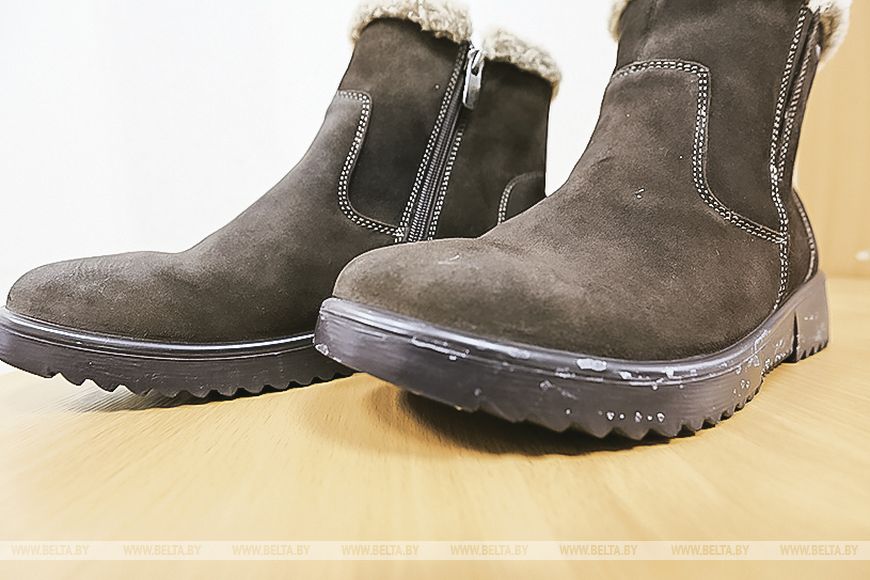
After consulting with our experts, we remove the three experimental shoes from the container filled with the salt & grit mixture exactly an hour later. At first glance, the father's and son's boots appear soaked in the slushy mess, while the mother's velour boots look as if we just took them off the shelf at the shoe store. All that’s left is to dry them and seek commentary from the specialists.
Drying took more than two days. The result was quite disappointing. The son's boots were covered with large white stains. The father's shoes had some dirty streaks as well, which only reaffirmed that it's still better to clean your shoes. The mother's boots remained almost in their pristine condition. Next we headed to one of the branches of the Yalina footwear service network in Minsk.



“The salt and grit used to treat streets in winter are absolutely harmless,” said Arseniy Pekun, a hygienist at the Department of Communal Hygiene at the Center for Hygiene and Epidemiology of the Leninsky District of Minsk. “These are organic natural materials that should not be feared. Cases of salt allergy are extremely rare.”
Technical salt corrodes the ice layer, breaks down its structure, and causes the ice to melt. Sand, in turn, provides the necessary traction for both footwear and vehicle tires. The hygienist assured that the invisible fumes generated by the reaction between salt and frozen water also pose no harm:
The only unpleasant effect, as we know, is the stains left on footwear and clothing, which carry no threat to health.
But what if we happen to touch a stain on a boot and then, without washing our hands, rub our skin or eyes?
“Naturally, direct contact of exposed skin with any type of salt should be minimized,” Arseniy Pekun noted. “But if you touch ordinary table salt at home and then rub your eye, the effect would be similarly predictable. Therefore, I would recommend wiping salt stains off shoes not with your hand but with a cloth or a sponge-like surface. Otherwise, the salt used on Belarusian streets is as safe as table salt. It is an eco-friendly product that is a logical choice for combating icy conditions.”
The expert notes that there are no specific measurements quantifying how much the incidence of injuries is reduced when streets are treated with salt or salt & grit mixtures:
However, speaking from my own and my acquaintances' experience, shoes indeed do not slip.
Painful to look at!
After consulting with our experts, we remove the three experimental shoes from the container filled with the salt & grit mixture exactly an hour later. At first glance, the father's and son's boots appear soaked in the slushy mess, while the mother's velour boots look as if we just took them off the shelf at the shoe store. All that’s left is to dry them and seek commentary from the specialists.
Drying took more than two days. The result was quite disappointing. The son's boots were covered with large white stains. The father's shoes had some dirty streaks as well, which only reaffirmed that it's still better to clean your shoes. The mother's boots remained almost in their pristine condition. Next we headed to one of the branches of the Yalina footwear service network in Minsk.
“Good shoes, nothing has come unstuck,” says Svetlana Kryzhenyuk, a footwear production technologist and head of the Yalina workshops. “For me, the answer was obvious in advance - the winner would be the mom who treated the velour boots with water-repellent spray. That is the best option. The spray initially prevents the salt from being absorbed and ruining the shoes. You can choose a specific product: for natural leather, for napped leather, for oiled leather, or use a universal one. However, not treating the shoes at all is not an option. You need to take care of them, even if you don’t enjoy doing it. Especially in winter.”
Svetlana Kryzhenyuk carefully inspects her son’s boot, which we had generously coated with black cream before the experiment:
“You did well by treating it. But it’s important to remember that the cream doesn’t provide a water-repellent effect. It created a film on the surface of the boot, so the salt couldn’t penetrate deeply. Removing the stains will be easier than on completely untreated shoes. On the father’s shoe, the salt has penetrated quite deeply, making it much harder to remove, whether at home or by professionals. Unfortunately, people don’t like taking care of their shoes. In the workshops, we often see that almost no cream has been applied to the pairs that come to us.”
Into the water again?
The son’s boot and the father’s shoe end up in the hands of the Yalina workshop technologist. She confirms the initial diagnosis:
“The son’s boot suffered the least because the cream created a protective layer, so all the salt remained on the surface. When the cream washes off, the salt will wash off with it. The dad’s shoe is more complicated. There was no treatment, and over a few days, the reagent soaked into the leather. We’ll wash the dad’s shoes, let them dry, but the salt may rise to the surface again. It will gradually seep out of the pores.”
Then the specialist simply slips the son’s boot onto her hand and begins washing it under running tap water using a sponge.
“The water should be warm, not hot. Hot water can “cook” the leather, while warm water will help dissolve some of the salt and wash away the cream, which is usually wax-based. For the same reason, cold water isn’t suitable either. Use a sponge or brush during washing. For better results, you can use liquid soap.”
The technologist insists that moisture itself won’t damage leather. The key is to dry it properly and in time.
“The sole will only come off if you wash shoes in boiling water and then put them to dry on a radiator. The primary purpose of footwear is to protect the foot from rain and snow, so boots and shoes are made from specialized materials that aren’t afraid of ordinary moisture. Look, my hand inside the boot is dry, which means no water seeped through. Immediately after washing, wipe the boots with paper towels and let them dry at room temperature.
The workshop staff stress that you must not dry shoes near a radiator, stove, or fireplace, otherwise, the sole will come unglued. It’s better to use special shoe dryers. And here’s another result for us: after washing, wiping, and drying, the son’s boot looks just like its untouched counterpart.
A tough case
Meanwhile, the dad’s shoe is going to be a bit of a project.
“To remove salt stains like this at home, we use paper towels or a cotton cloth,” they explain at the workshop. “After dampening it, we completely wrap the shoe. If any surface is left exposed, the salt will migrate there. Once the towel dries, we replace it with a damp one. Then, you’ll need to let the dad’s shoe dry for about a day at room temperature.”
Wait a minute, but the family’s father can’t exactly go to work in wet boots!
“It’s best not to wear the same pair of shoes every day,” advises Svetlana Kryzhenyuk. “Ideally, each person should have two or three pairs to rotate through during the winter season. If someone only has one pair, they most often dry them on the radiator, which just ruins them. Without a protective spray, I wouldn’t advise going out at all. You should apply it to dry shoes and well in advance, about six hours before you plan to go outside. So, it’s better to do this treatment on a weekend. The main thing for the rest of the week is to rinse off the soles every evening.”
In the workshop, the dad’s shoes are cleaned with a steam cleaner, a special device that emits steam at 60-70 degrees Celsius.
“At home, you cannot use a garment steamer for this purpose, nor should you follow grandma’s old trick of holding shoes over a pot or kettle of boiling water. You’ll just ‘cook’ and ruin the leather,” the specialists warn.
After the steam treatment, they remove excess moisture from the dad’s shoe with paper towels and place it in a special drying cabinet. This is a professional apparatus costing several thousand euros, which can also ozonate the shoes, killing bacteria and fungi.
In a workshop setting, it is possible to restore almost any pair of winter footwear to its original condition. The main thing is that salt etching hasn’t started, causing the leather to become bumpy. Even if the salt is removed, the swollen areas will remain deformed. However, professional shoe cleaning services aren’t for everyone – they’ll set you back at least Br50. This cost includes both the cleaning and the ozonation.
“Overall, the dad’s shoes look as good as new,” the technologists conclude. “You won’t ruin shoes in a single day if you remove the salt in the evening. But if you never clean them, degradation will start from within the leather itself.”
“The winter footwear you buy in a store has always been treated with a professional water-repellent spray,” Svetlana Kryzhenyuk points out. “To wash it off, you’d need to soak the boots in a basin of water for several hours or wear them for about a month without re-treating them. Worn-in shoes would have shown completely different results. In that case, specialized cleaning agents would have been necessary. In this instance, however, we were able to restore both the boot and the shoe to their original appearance.”
We leave the specialists’ workshop with three boxes of nearly new shoes in our hands. Today, we’ve learned that the salt used to treat the streets is harmless to people and helps reduce injuries. But on shoes without water-repellent treatment, it leaves white stains. Fortunately, these can be removed both at home and professionally. The most important thing is not to forget regular care for your winter “all-terrain vehicles.” Tested!
Handy tips
-If you forget to treat your boots or shoes with protective spray before leaving home in winter, it’s best to wrap them in damp towels upon your return and leave them overnight. This helps the material draw out as much salt as possible from the leather.
-Always dry footwear at room temperature, away from radiators, stoves, and fireplaces. You can also use special shoe dryers.
-The salt used in Belarus to treat streets during the cold months is harmless to humans.
Our thanks to the Marko company for providing the footwear used in this test.
Aleksei Gorbunov,
photos by Anastasiya Taranko, Ramil Nasibulin, Vadim Kondratyuk,
7 Dnei newspaper.