
AP Photo
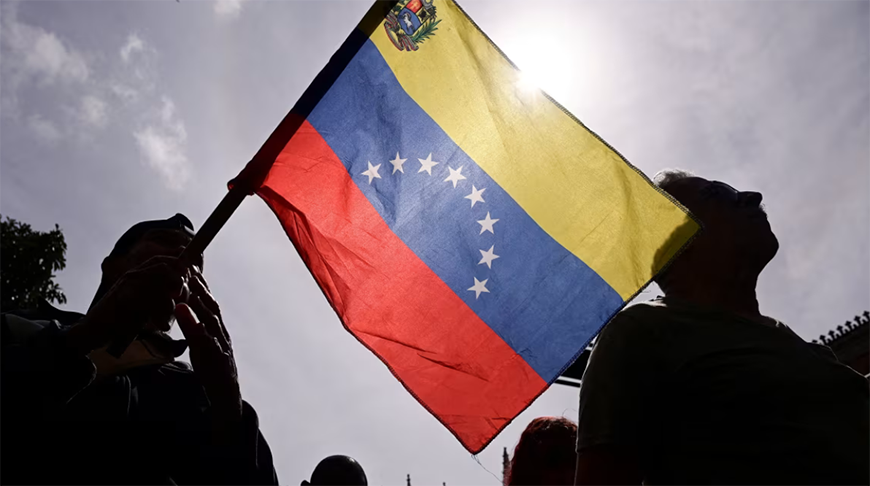
The world continues to discuss the U.S. military operation in Venezuela. The attack on civilian and military facilities, the capture of the country's President Nicolás Maduro and his wife, the statement by U.S. leader Donald Trump about his intention to take temporary control of Venezuela and sell Venezuelan oil to other countries… All of this has provoked a sharp reaction from the international community. Some have categorically condemned the act of U.S. aggression, others have welcomed the “pressure” from the United States, while yet others are performing a political split attempting to maintain a “democratic” facade without offending Trump.

However, regardless of the varied reactions, everyone understands that the concept of international law, in essence, no longer exists. What remains is “the might is right”. Exercising this “right”, the United States will tonight commence a travesty court trial of Venezuela's legitimate president and his spouse. The charges against the Venezuelan leader will be presented in a New York court.
Meanwhile, Trump is making it clear that Venezuela may not be the end of it. Threats are emanating from Washington towards Cuba, Mexico, and Colombia, and claims over Greenland have been revived. However, the Western Hemisphere alone may not satisfy their ambitions. Just a few days ago, the U.S. leader pledged to come to the aid of protesters in Iran, declaring that the United States is in “full combat readiness”.
Where are such ambitions leading the United States, and where did the Trump administration go wrong? We reflect on this in BelTA's analysis.
What does Trump want?
The U.S. president speaks openly about his desires. First, to establish a regime in Venezuela that is loyal to U.S. interests. Second, to gain control over the country's natural resources.
The first is necessary to achieve the second. But that’s not all. The U.S. National Security Strategy, published at the end of 2025, explicitly calls for a return to the Monroe Doctrine which asserts U.S. dominance in the Western Hemisphere. The United States does not want to see any external players, primarily Russia and China, in what it considers its own hemisphere.
During a press conference on 3 January, Trump stated that Venezuela, under Maduro's rule, had been “increasingly hosting foreign adversaries in our region and acquiring menacing offensive weapons that could threaten U.S. interests.” Trump also emphasized that “under our new national security strategy, American dominance in the Western Hemisphere will never be questioned again.”
In other words, to secure U.S. dominance and protect U.S. interests, even from hypothetical threats, Washington is willing to carry out a “cleanup” in a region it considers its sphere of influence.
Venezuela’s natural resources, primarily oil, are a substantial bonus. Trump has already stated that the U.S. intends to sell Venezuelan oil to other countries and increase these shipments. If this plan is implemented, Washington would not only gain financially but could also acquire leverage over the global oil market in the long run. Experts estimate that combined U.S. and Venezuelan oil could account for about 20% of the world’s supply.
For the Trump administration, Venezuela could have been a success story. With the operation in Caracas, the White House tried to kill several birds with one stone: throw a bone to the oil lobby and war‑hungry American hawks (including among Republicans), pave the way for strengthening the U.S. position in the oil market, and officially lay claim to the Western Hemisphere. Did it all work out?
Where did the USA go wrong?
As far back as the end of last year, while commenting on the escalating tensions between Washington and Caracas, Belarusian leader Aleksandr Lukashenko warned: Venezuela could become a second Vietnam for the USA. “A war will achieve nothing. I spoke to John Coale about this yesterday. I told him, this will be a second Vietnam. Do you need that? You don’t. So there should be no war there,” the president said in an interview with the U.S. television network Newsmax.
The USA did not want to be dragged into a “second Vietnam”, so in the first stage, they carried out a targeted operation aimed at decapitating and disorienting the adversary. After that, much would depend on political decisions in Caracas. If they decided to settle, the Trump administration would get its success story. However, if the Chavistas decided to hold out to the end, the U.S. “extraordinary” military operation would turn into a headache for Washington. Bombing from the air is one thing; engaging in ground combat is another. Under the current balance of power in the USA, a “second Vietnam” would be a triumph for the Democrats and political suicide for Trump and the Republican Party. The only way out in such a situation would be to withdraw. But that, once again, would be a blow to the U.S. leader’s reputation.
The Trump administration could have achieved its success without political risks. The Belarusian president also noted that the situation in U.S.-Venezuela relations could have been resolved in an entirely peaceful way. He emphasized that the interest of the United States in nearby Venezuela is quite understandable. As is, for example, Russia’s interest in the situation in Ukraine. “I am absolutely convinced that all issues, all wishes of the United States of America can be resolved today in an absolutely peaceful way,” the president said in December. “War will lead nowhere.”
In essence, the United States faced a choice: to pursue the path of peace or confrontation. It is quite likely that the White House believed that a show of force would achieve its goals more quickly in Venezuela and in other countries of the Western Hemisphere. But by gaining its “moment of glory” on 3 January, the Trump administration may have deprived itself of the long-term success it could have achieved by choosing the peaceful path. And this, one may assume, is the main mistake of Trump and his team.
What does this mean? Probably that the image of Trump as a peacemaker in the eyes of the global public, and above all the countries of the Global South, collapsed on 3 January. Yet until that moment, the Trump administration had done enormous work to strengthen the image of the United States. And even though Washington focused on quantity rather than quality, the American leader’s peace efforts were recognized worldwide. More than that, Trump managed to “erase” the stigma of the USA as the instigator of a proxy war in Ukraine. In an instant, the war unleashed by the American elites became Biden’s war personally, and the United States appeared as a peacemaker.
But the events in Venezuela clearly showed that the U.S. aggressive policy is consistent and continuous. Moreover, it is becoming increasingly unconstrained in its execution. Back in 2003, U.S. Secretary of State Colin Powell waved a vial of white powder at the UN Security Council in an attempt to justify the impending U.S. invasion of Iraq before the world community. And today, U.S. Secretary of State Marco Rubio declares that even the U.S. Congress was not informed about the operation against Venezuela, because the White House did not want a “leak” of information.
Where is this heading?
“What unfolded overnight in Venezuela will cause immediate anxiety to governments like Iran and Denmark, against which Trump has expressed enthusiasm for taking radical action,” wrote the British newspaper The Guardian.
“The decapitation of Venezuela’s leadership has already become a lesson and a signal to the rest of the world. The lesson confirms that Trump intends to resort to force whenever he considers it necessary,” the French newspaper Le Figaro noted.
“The leading Western power now openly ignores international norms, such as territorial integrity and state sovereignty, and makes no attempt to conceal this,” the German newspaper Handelsblatt stated.
International law, long in a state of paralysis, now seems to be dead and buried. What are the consequences? In all probability, the definitive formation of power blocs. Amid global turbulence and a sense of lawlessness, numerous vulnerable states are likely to turn to powerful regional players with nuclear capabilities for security. At the same time, major powers will increase their political weight and strengthen their positions by relying on their allies.
It can be assumed that the influence of regional and international organizations will also grow, including the Shanghai Cooperation Organization (SCO), BRICS, and the Collective Security Treaty Organization (CSTO), which will remain centers of attraction for a growing number of countries.
The result for the United States is paradoxical. The very measures taken by the Biden administration like turning the dollar into a weapon, freezing Russian assets, cutting off Russian and Belarusian banks from SWIFT ended up accelerating the shift they feared: pushing the non-West to adopt national currencies, build rival payment networks, and forge collective defenses against U.S. and allied interference. Thus, by trying to slow down changes in the world, the Biden administration, on the contrary, accelerated the processes of transformation.
And now the Trump administration is repeating Biden’s mistake. Early in his presidential term, Trump acknowledged that multipolarity had become the reality of today. But instead of integrating into the new reality, the United States began carrying out interventions, imposing its will through suppression and domination. Undoubtedly, as one of the centers of power, Washington has many levers of pressure. Yet by pursuing such a policy, will the United States be able to become a center of attraction in a multipolar world? There are serious doubts about that.
Vita KHANATAYEVA,
BelTA
Photos from BelTA archive, Pixabay