
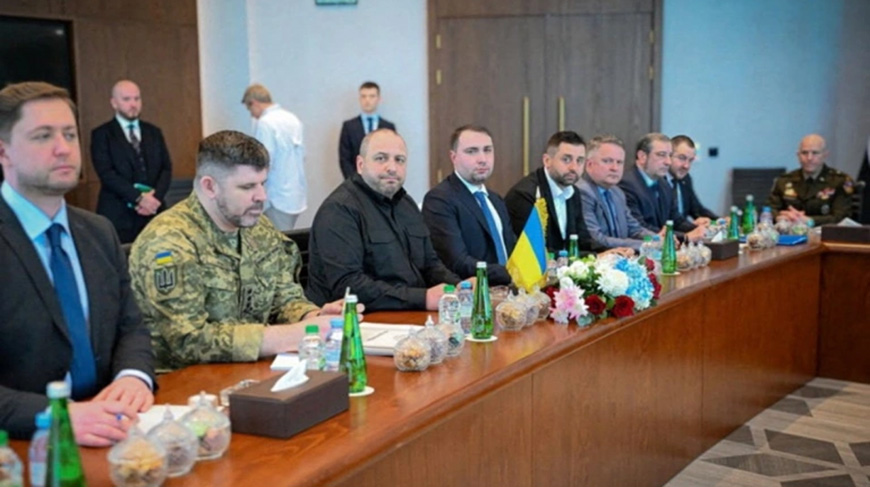
Last week, the second round of negotiations on the Ukrainian conflict took place in the capital of the UAE. The meetings on Ukraine are held behind closed doors, and very little information is made public. However, over the past few days, quite intriguing insider details regarding the negotiations have surfaced in Western media. Official statements have also been made regarding a peaceful settlement, the positions of the parties, and the importance of dialogue.
‘The Americans are in a hurry.’ What are Reuters sources saying?
A peace agreement to settle the Ukrainian conflict in March, followed by a referendum and presidential elections in Ukraine in May. This is the plan the United States is reportedly pursuing regarding a peaceful settlement in Ukraine, according to Reuters. The agency cites unnamed sources, and there has been no official confirmation from Washington. However, recent statements by Vladimir Zelensky align with the information reported by Reuters.
“U.S. and Ukrainian negotiators have discussed an ambitious March goal for Russia and Ukraine to agree on a peace deal, though that timeline is likely to slip given a lack of agreement on the key issue of territory, according to three sources familiar with the matter,” reads the Reuters report published shortly after Abu Dhabi.
According to Reuters, under the framework being discussed by U.S. and Ukrainian negotiators, any deal would be submitted to a referendum by Ukrainian voters, who would simultaneously vote in national elections. According to Reuters sources, the U.S. negotiating team - led by special envoy Steve Witkoff and President Donald Trump's son-in-law Jared Kushner - has expressed to Ukrainian counterparts in recent meetings in Abu Dhabi and Miami that it would be best if that vote occurred soon, three of those sources said.
“The Americans are in a great hurry,| said a Reuters source familiar with the situation. This is because the President Donald Trump administration intends to focus on U.S. domestic affairs as the November congressional elections approach.

‘The Americans are in a hurry.’ What are Reuters sources saying?
A peace agreement to settle the Ukrainian conflict in March, followed by a referendum and presidential elections in Ukraine in May. This is the plan the United States is reportedly pursuing regarding a peaceful settlement in Ukraine, according to Reuters. The agency cites unnamed sources, and there has been no official confirmation from Washington. However, recent statements by Vladimir Zelensky align with the information reported by Reuters.
“U.S. and Ukrainian negotiators have discussed an ambitious March goal for Russia and Ukraine to agree on a peace deal, though that timeline is likely to slip given a lack of agreement on the key issue of territory, according to three sources familiar with the matter,” reads the Reuters report published shortly after Abu Dhabi.
According to Reuters, under the framework being discussed by U.S. and Ukrainian negotiators, any deal would be submitted to a referendum by Ukrainian voters, who would simultaneously vote in national elections. According to Reuters sources, the U.S. negotiating team - led by special envoy Steve Witkoff and President Donald Trump's son-in-law Jared Kushner - has expressed to Ukrainian counterparts in recent meetings in Abu Dhabi and Miami that it would be best if that vote occurred soon, three of those sources said.
“The Americans are in a great hurry,| said a Reuters source familiar with the situation. This is because the President Donald Trump administration intends to focus on U.S. domestic affairs as the November congressional elections approach.
Two of the sources said U.S. and Ukrainian officials had discussed the possibility that the national election and referendum could occur in May. But several sources with visibility into the negotiations described the U.S.-proposed timeline as fanciful. Ukrainian election authorities have projected that it would take around six months to organize an election under current conditions… Organizing such an election would require legislative changes, as such votes are prohibited during martial law in Ukraine. It would also be costly, Reuters reported
According to Reuters, Ukraine wants a ceasefire throughout the voting campaign to protect the referendum's integrity, and says the Kremlin has a history of breaking its word on agreed-upon halts in fighting, one of the sources said. “Kiev's position is that nothing can be agreed until the security guarantees for Ukraine from the United States and partners are in place,” the Reuters source said.
Another issue on which positions diverge is the territorial one. “There's still no progress on the territorial question,” a Reuters source familiar with the matter said.
The fate of the Zaporozhzhye power plant, which sits in Russian-controlled territory, has also proven a sticking point. “One source noted Russia has pushed back on a U.S. proposal under which Washington would control the plant and distribute its power to both Russia and Ukraine. Moscow insists that it control the plant, while offering Ukraine cheap power, a proposal Kiev finds unacceptable,” Reuters said.
According to Reuters, Ukraine wants a ceasefire throughout the voting campaign to protect the referendum's integrity, and says the Kremlin has a history of breaking its word on agreed-upon halts in fighting, one of the sources said. “Kiev's position is that nothing can be agreed until the security guarantees for Ukraine from the United States and partners are in place,” the Reuters source said.
Another issue on which positions diverge is the territorial one. “There's still no progress on the territorial question,” a Reuters source familiar with the matter said.
The fate of the Zaporozhzhye power plant, which sits in Russian-controlled territory, has also proven a sticking point. “One source noted Russia has pushed back on a U.S. proposal under which Washington would control the plant and distribute its power to both Russia and Ukraine. Moscow insists that it control the plant, while offering Ukraine cheap power, a proposal Kiev finds unacceptable,” Reuters said.
The agency also reports that public opinion polls indicate that a growing number of Ukrainians believe it is necessary to make concessions in exchange for security guarantees from the West.
“We stand where we stand.” What did Zelensky say?
Vladimir Zelensky has essentially confirmed Reuters’ reporting on U.S. plans to negotiate an end to the conflict in Ukraine by summer, according to the Ukrainian publication Strana.
“The Americans want to see the end of the war by early summer. They say they want to get everything done by June and they want a clear schedule for all events,” Zelensky stated. He suggested that as the U.S. election approaches, domestic issues will become a higher priority for the Trump administration.
When asked whether this meant the U.S. might withdraw from talks if peace is not achieved, Zelensky replied that he had received no such message from the negotiating team.
He also announced that the U.S. had proposed holding the next round of trilateral talks this week, with American territory, possibly Miami, under consideration as the venue for the first time. The Ukrainian delegation has already confirmed its readiness to participate.
Zelensky added that ceasefire monitoring would be conducted by Ukraine, Russia and the United States once hostilities cease, meaning Kiev’s European allies would not take part. According to Zelensky, the militaries of the three countries have already agreed on the technical details, and the U.S. has confirmed its participation.
On the issue of Crimea, Zelensky remarked, “I believe that Russia is most likely sending a signal to America to recognize Crimea.” He made it clear that Ukraine would not uphold any such arrangements.
Kiev also opposes the withdrawal of Ukrainian troops from Donbass. “Russia wants us to leave Donbass, but in our view, ‘We stand where we stand’ is the most reliable model for a ceasefire at this stage,” Zelensky noted, adding that the matter remains under discussion.
Another notable statement by Zelensky concerned the so‑called “Dmitriev package” (a reference to Kirill Dmitriev, the Russian president’s special envoy involved in talks with the Americans). This package aims to strengthen economic cooperation between Russia and the United States. Citing intelligence, Zelensky said the two countries could sign a $12 trillion trade agreement and noted that the package might be linked to a settlement in Ukraine. “We clearly state that Ukraine will not support even potential agreements about us without us,” he stated.
In the spirit of Anchorage. What does Moscow say?
Moscow’s position on Ukraine was clearly outlined by Russian presidential press secretary Dmitry Peskov, who stated that Russia remains open to a peace deal but hostilities will continue until Kiev makes “appropriate decisions.”
“Our position is crystal clear, and it is well understood by both the Kiev regime and the American negotiators, who are providing their good offices in conducting the trilateral talks, and to whom we are grateful for their efforts,” Peskov said on 4 February.
“Russia is continuing the special military operation. The door to a peaceful settlement is open, and Russia maintains its openness. But until the Kiev regime makes appropriate decisions, the special military operation continues,” the Kremlin spokesman added.
Peskov also noted that Russia and the United States are working to implement the agreements reached by the two countries’ presidents in Alaska, which include the settlement of the conflict in Ukraine.
“There are a number of understandings that were reached in Anchorage, which were voiced even on the eve of Anchorage, during Mr Witkoff’s visit here,” Dmitry Peskov stated. “These understandings achieved in Anchorage are fundamental, and it is precisely these understandings that can move the settlement process forward and allow for a breakthrough.”
Peskov noted that regarding the negotiations on Ukraine, Russia would prefer not to go into details. “We remain convinced that it is in the interest of the matter to conduct these talks behind closed doors, and not engage in some kind of public, megaphone diplomacy,” the Kremlin representative said.
He also reported that a new round of negotiations on Ukraine will take place in the near future. However, there has been no talk so far about holding a trilateral meeting in the USA, as Zelensky mentioned.
Russian Foreign Minister Sergey Lavrov also recalled the agreements reached in Anchorage. His statements, made during an interview for the international network TV BRICS, were reported by TASS.
“We are told that the Ukrainian problem needs to be solved. In Anchorage, we accepted the proposal of the USA. If we approach this in a manly way, they proposed - we agreed, meaning the problem should be solved,” the minister said.
“Russian President Vladimir Putin has repeatedly said that for Russia it is not important what they say in Ukraine or in Europe; we perfectly see the primitive Russophobia of most regimes in the European Union, with very rare exceptions. What was important to us was the position of the USA,” Lavrov added.
The Russian foreign minister noted that by accepting Washington’s proposal on Ukraine, Russia was ready to transition to full-scale, broad, mutually beneficial cooperation with the USA. “So far, in practice, everything looks the opposite: new sanctions are being imposed, a ‘war’ is being waged against tankers on the high seas in violation of the UN Convention on the Law of the Sea. Attempts are being made to forbid India and our other partners from buying cheap, accessible Russian energy resources (Europe was forbidden long ago) and they are being forced to buy expensive U.S. liquefied natural gas at three times the price. That is, in the economic sector, the Americans have declared the task of economic dominance,” the diplomat said.
Lavrov also reported that representatives of European countries are sending messages through non-public channels that they want to be at the negotiating table for a Ukrainian settlement.
“Fanaticism of war”: What are they thinking in Europe?
In recent months, calls to resume dialogue with Russia have been heard more and more frequently in European capitals. French President Emmanuel Macron has spoken about this repeatedly. He was supported by Italian Prime Minister Giorgia Meloni. According to Western media reports, the European community is discussing the possibility of appointing a point person for resolving the conflict in Ukraine and for dialogue with Moscow.
On 4 February, French media reported on a visit to Moscow by Emmanuel Bonne, Diplomatic Advisor to French President Emmanuel Macron. On 5 February, the current OSCE Chairperson-in-Office, Head of the Swiss Federal Department of Foreign Affairs Ignazio Cassis, and OSCE Secretary General Feridun Sinirlioğlu arrived in the Russian capital for talks.
“After our visit to Ukraine, I arrived in Moscow today together with OSCE Secretary General Sinirlioğlu. Dialogue requires engagement with all sides,” Cassis wrote on social media platform X.
According to a TASS Western source, representatives of European countries made several attempts to join the consultations on Ukraine in Abu Dhabi, but without success.
As a result of negotiations with Lavrov Cassis acknowledged that there had been no real dialogue on the settlement in Ukraine in recent years and that the world had only witnessed monologues from individual parties. “Our goal was not to reach an agreement in Moscow, but to establish dialogue,” the minister said, calling for a resumption of diplomatic efforts to resolve the conflict in Ukraine.
Meanwhile, Hungarian Minister of Foreign Affairs Peter Szijjarto is confident that if Europeans had not opposed Trump’s peace efforts, the conflict in Ukraine would already be over. “From the very beginning Europeans have viewed this war as their own. They say, 'This is our war. In fact, it is not our war,“ said the minister of foreign affairs, noting that “war fanaticism” reigns in Europe.
The Italian publication L’AntiDiplomatico writes about attempts of European officials to thwart efforts to resolve the Ukrainian conflict. It draws attention to the visits to Kiev by NATO Secretary General Mark Rutte and Polish Prime Minister Donald Tusk on 3 February and 5 February respectively. The publication reports that the purpose of Rutte’s and Tusk’s visits was to convince Zelensky to undermine the negotiation process and continue military operations.
Meanwhile, the British publication The Daily Telegraph reported that European Commission President Ursula von der Leyen is preparing the European Union for war with Russia by 2030. According to the publication, the head of the European Commission is taking measures to ease debt rules in the EU in order to finance defense spending to the tune of €650 billion.
Finnish President Alexander Stubb has recently commented on statements by some Western politicians about possible Russian aggression against NATO countries. He is convinced that such statements come from politicians who know nothing about the geopolitical or military strategy of the Russian Federation. “I’m not worried about that. Certainly, we are prepared for various scenarios, but there is too much noise surrounding this. And this noise is usually created by people who do not have a profound understanding of the Russian geopolitical or military strategy,” Stubb said in an interview with the Foreign Affairs magazine.
While some are calling for the war to continue, others are appealing to common sense. Luxembourg MEP Fernand Kartheiser called for the restoration of good relations with Russia and Belarus to ensure security and stability in Europe.
“Western Europe certainly does not need to strive for defense spending levels comparable to those of the United States, as it does not need the same forces. Only a relatively small part of the U.S. defense budget is allocated to NATO. Western Europe should not have ambitions to become a global military power. The only thing it should strive for is to ensure security and stability in Europe. There is no doubt that in order to facilitate this process, it is necessary to restore good relations with Russia, Belarus, and other countries,” Kartheiser said in a recent interview with TASS.
In his words, in a multipolar world the United States will no longer be able to maintain its current level of involvement in European affairs. “There is no doubt that Europe will have to increase its defense efforts. However, these efforts can and should be limited to the minimum necessary expenditure and should not lead to an arms race,” he said.
Kartheiser noted that Western European countries should first and foremost build a security architecture together with Russia, not against it. “Measures to build trust, arms limitation agreements, and verification mechanisms are needed. The successful implementation of such a policy would prevent an arms race and limit defense spending to more acceptable levels,” the politician concluded.
By BelTA’s Vita KHANATAYEVA