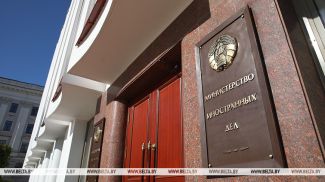

MINSK, 23 February (BelTA) – Belarusian Deputy Minister of Foreign Affairs Igor Sekreta made a speech during a high-level segment of the UN Conference on Disarmament in Geneva, Switzerland on 23 February, representatives of the Belarusian Ministry of Foreign Affairs told BelTA.
“Since its inception the Conference on Disarmament like its predecessor, the Disarmament Committee, has made an enormous contribution to ensuring international peace, security, and stability. Unfortunately, the hope that the new system of international relations in the period after the Cold War would be based on mutual respect and cooperation rather than rivalry gave rise to a false sense of complacency,” Igor Sekreta noted.
“Peace and security have come to be taken for granted,” he noted. “The so-called victors in the Cold War have decided to abandon the principle of equal and indivisible security and to disregard the legitimate security concerns of other countries. The mechanisms of non-proliferation, arms control, and disarmament, which have long served as the connective tissue of the architecture of international and regional security, are collapsing and decaying before our eyes, but this process began long before today.”
The deputy minister expressed regret that the Russian-American treaty on strategic offensive arms had expired just over two weeks before. “We hope that the dangerous vacuum in nuclear arms control that has emerged for the first time since the early 1970s will be filled by a new multilateral document,” Igor Sekreta stressed.
In his words, against the backdrop of the deteriorating system of international obligations and legal guarantees in the field of security, and the disregard for international law, the world has once again returned to a point where the nuclear threat is clearly visible.
“Intimidation, disinformation, and dehumanization of potential adversaries as well as the priority development of the military-industrial complex are becoming increasingly important. Under the pretext of a mythical threat from the East, NATO is taking unprecedented measures to increase its members’ military spending to 5% [of the GDP]. The total military spending of the Alliance’s member countries has long exceeded $1 trillion,” the deputy minister continued. “In fact, the European military-industrial complex has been ramped up to wartime levels. Why, if, as our Western neighbors claim, they have no intention of attacking Belarus? After all, no one spends money on missiles, mines, and tanks for no reason.”
The deputy minister of foreign affairs of the Republic of Belarus also noted: “The recent withdrawal of our neighbors from the Convention on the Prohibition of Anti-Personnel Mines contributes to the destruction of the international humanitarian law system, to the escalation of military and political tensions in the region, and plays into the hands of arms corporations. Who are they going to fight against with anti-personnel mines? It turns out that they are going to fight against their own citizens who live near the border. I think there are many military experts, representatives of special services, and people associated with special services and military agencies in this hall, who do not need to be told about the dangers of anti-personnel mines and their destructive effects, which are linked to the lack of accurate plans and schemes of their deployment. In Belarus, a country that survived World War Two, unexploded ordnance is still getting excavated during construction work. And our neighbors, having voluntarily withdrawn from the Convention on the Prohibition of Anti-Personnel Mines, are now building up this dangerous arsenal and will use it.”
“American tactical nuclear weapons continue to be located in a number of European countries,” Belarus’ representative pointed out. “Anti-missile defense systems are deployed in Poland. Their technical capabilities make it possible to use Tomahawk cruise missiles. Certain European countries have announced their intention to deploy American medium- and short-range missiles in their territory or to purchase the appropriate weapons systems.”
He asked a rhetorical question: “How can a country like Belarus defend itself in the absence of reliable security guarantees and real confidence-building measures?”
“We are not getting involved in a mindless arms race by radically increasing military spending. We have other things to spend our money on: on the elderly and children, on improving the economic well-being of our citizens,” concluded the deputy minister of foreign affairs of the Republic of Belarus.