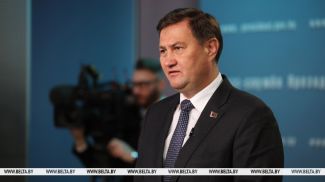

MINSK, 27 January (BelTA) – Belarus and Japan intend to advance inter-parliamentary and interregional cooperation, Sergei Aleinik, Chairman of the Standing Commission on International Affairs and National Security of the Council of the Republic of the National Assembly of Belarus, told journalists following a meeting with Ambassador Extraordinary and Plenipotentiary of Japan to Belarus Kazuhiro Kuno, BelTA has learned.
“We dedicated today’s meeting to discussing the development and deepening of our bilateral relations. We agreed to intensify inter-parliamentary cooperation between our countries. There was once a friendship group in the Japanese parliament, and we hope it will resume its work. We agreed to start with contacts between the parliaments of our two countries on the platforms of international organizations, such as the Inter-Parliamentary Union and the OSCE Parliamentary Assembly. Of course, we also gave consideration to interregional cooperation. Currently, there is only one sister-city agreement between our countries. We agreed to consider concrete steps to develop interregional cooperation between Belarus and Japan,” Sergei Aleinik said.
The meeting also discussed prospects for enhancing trade and economic interaction between the two countries, support for implementing joint economic projects, establishing cooperation between chambers of commerce and industry, and deepening scientific and technical collaboration, which, according to Sergei Aleinik, already has its history but now requires a new impetus.
“We also focused on humanitarian cooperation and issues of particular importance on our bilateral agenda. We highly value the assistance Japan provided to our country in mitigating the consequences of the Chernobyl disaster. Assistance was provided both by the Japanese government and by a number of Japanese public organizations, totaling about $40 million. Furthermore, since 2004, Japan has launched the Grassroots program aimed at strengthening the technological base of Belarusian healthcare institutions. This program was resumed last year, and three projects to supply high-tech medical equipment have already been implemented. We greatly value this cooperation and have agreed with the ambassador on the further development of the humanitarian dimension of our bilateral relations,” Sergei Aleinik emphasized.
On 26 January, Belarus and Japan marked the 34th anniversary of establishing diplomatic relations. This period saw a certain level of mutually beneficial cooperation forged. There are achievements in the legal framework, with a number of bilateral agreements in force concerning science and technology and interaction in radiation safety.
The Grassroots Grant Assistance program is one of the programs implemented by the Japanese government abroad. This program funds humanitarian projects proposed by organizations and selected through a competitive process. In Belarus, the program has been implemented since 2004. Its main goal is to assist people affected by the Chernobyl nuclear power plant disaster and its consequences. Within the framework of the program, medical equipment has been supplied to hospitals located in regions affected by the Chernobyl disaster, as well as to oncological and endocrinological medical institutions in Belarus (about 100 units of medical equipment, including endoscopic equipment, ultrasound machines, dental units, ambulances, electrocardiographs, etc.). Priority is given to projects related to the diagnosis and treatment of thyroid diseases. In addition, grant funds may be allocated to strengthen the material base of social protection organizations.
Prior to 2022, the program allocated around $200,000 to $400,000 to Belarus annually. As part of the program, a $72,000 grant contract was signed with the Senno Central District Hospital on 3 February 2025 for the procurement of an endoscopic system. Under the program, a $123,700 grant contract was signed on 13 March 2025 to procure colonoscopy equipment for the Gomel Oblast Oncology Center. This was followed by another grant contract signed on 16 January 2026, amounting to $65,700 for medical equipment supplied to the Stolin Central District Hospital. Belarus has received a total of around $4.9 million in aid through this program since its launch in 2004, funding 63 projects.