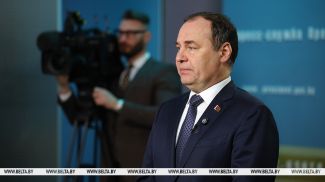

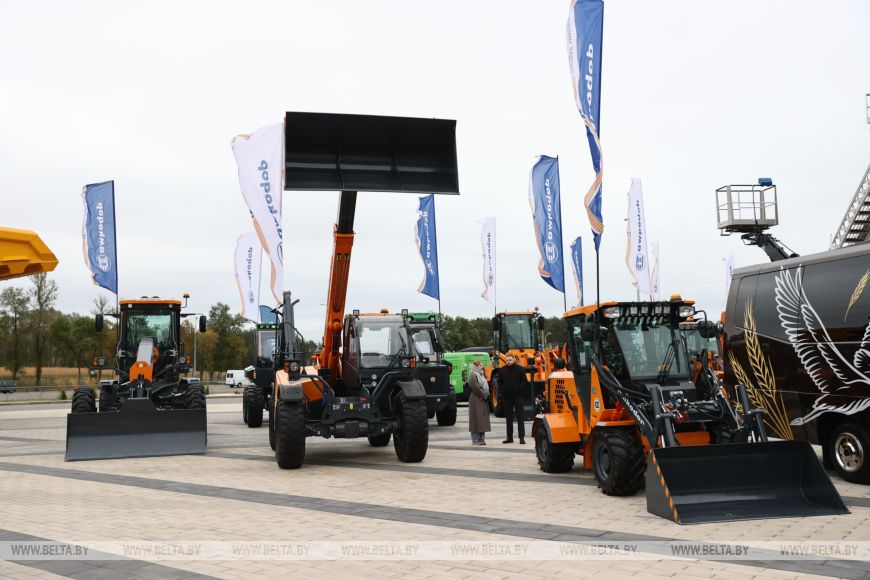
Given the robust development of the industrial sector and the growing role of import substitution efforts, Amkodor Holding Company maintains its position as one of the key players in the domestic mechanical engineering industry. At the same time, the enterprise continues its course towards technological modernization and expansion of its export potential. In an interview with BelTA, Director General of Amkodor - Managing Company of the Amkodor Holding Company Aleksandr Yefimov, spoke about the company’s performance in 2025, new promising machinery, and changes in the export structure.
What goals does the holding company face for 2026?
The team has developed quite ambitious development plans for 2026. They will ensure not only a recovery growth in key performance indicators such as production volumes and exports but also achieve the best results in most parameters in the entire history of the company’s operations. In terms of sales revenue, we eye a growth rate of 40%, and in terms of exports - more than 70% over 2025. At the same time, absolute export figures will also be among the best.
The investment development program was revised in accordance with the instructions from the head of state. Previously, we were implementing or had planned to implement about 21 investment projects. Currently, we have focused on 10 of the most promising projects with a high degree of readiness and maximum economic effect. These will be completed in 2026. After that, we will begin developing a new development program.
In particular, this year we plan to complete the modernization of the Amkodor-Mozha enterprise in the town of Krupki, the leading manufacturer in the CIS countries of grain cleaning and drying complexes and grain storage systems. This year we are planning to bring two integration import-substituting projects to the design capacities. These include the timber industry machinery production at Amkodor-Lesmash in Logoisk and the manufacturing of a model range of manipulators for forestry equipment at Amkodor-Semash in Dzerzhinsk.
We are completing the investment phase of the project to develop key transmission components of our own design: drive axles, hydromechanical gearboxes, and a reduction gear group, both for the Amkodor vehicles and for Russian customers.

The year 2025 is behind us. Mr Yefimov, will you please tell us about the main results and indicators that the company approached the new stage?
Certainly, it's worth starting with the fact that last year, serious support measures for the holding company were adopted at the level of the head of state and the government. These decisions made it possible to stabilize financial and economic activities and improve all key performance indicators. As an example, I can note that in the second half of the year, we ramped up the production by 20% compared to the first half of 2025, and by the end of the year we achieved profitable operations.
Certainly, it's worth starting with the fact that last year, serious support measures for the holding company were adopted at the level of the head of state and the government. These decisions made it possible to stabilize financial and economic activities and improve all key performance indicators. As an example, I can note that in the second half of the year, we ramped up the production by 20% compared to the first half of 2025, and by the end of the year we achieved profitable operations.
What goals does the holding company face for 2026?
The team has developed quite ambitious development plans for 2026. They will ensure not only a recovery growth in key performance indicators such as production volumes and exports but also achieve the best results in most parameters in the entire history of the company’s operations. In terms of sales revenue, we eye a growth rate of 40%, and in terms of exports - more than 70% over 2025. At the same time, absolute export figures will also be among the best.
The investment development program was revised in accordance with the instructions from the head of state. Previously, we were implementing or had planned to implement about 21 investment projects. Currently, we have focused on 10 of the most promising projects with a high degree of readiness and maximum economic effect. These will be completed in 2026. After that, we will begin developing a new development program.
In particular, this year we plan to complete the modernization of the Amkodor-Mozha enterprise in the town of Krupki, the leading manufacturer in the CIS countries of grain cleaning and drying complexes and grain storage systems. This year we are planning to bring two integration import-substituting projects to the design capacities. These include the timber industry machinery production at Amkodor-Lesmash in Logoisk and the manufacturing of a model range of manipulators for forestry equipment at Amkodor-Semash in Dzerzhinsk.
We are completing the investment phase of the project to develop key transmission components of our own design: drive axles, hydromechanical gearboxes, and a reduction gear group, both for the Amkodor vehicles and for Russian customers.
This year we are also planning new projects to expand production capacities for our traditional line of front-end loaders. We are considering scaling up the production of excavator machinery and bulldozers for the road construction and land reclamation sectors. We will also be working on scaling up the production of agricultural machinery - trailed and mounted agricultural implements that we manufacture in Dzerzhinsk.
Additionally, we are looking for options to create additional capacities for producing the line of electric and engine-powered forklifts, electric carts, and transport and logistics equipment at Amkodor-Unikab in Molodechno.
We are working on the creation of new capacities and the modernization of existing ones together with local executive authorities and the State Committee on Science and Technology. Overall, we expect to finish this year with good results, including in terms of net profit.
What volume of investments is planned for the current year?
Investments this year will be roughly comparable to last year’s level. A volume of no less than $25 million is planned. These funds will be directed primarily toward completing already launched projects and forming a new investment cycle. We expect to implement these projects with the support of accessible financing mechanisms for all stages of innovation activity - from scientific and technical developments to production preparation, using available funds from the State Committee on Science and Technology and local executive committees on a competitive basis.
How is the export structure changing? Which markets is the holding company entering?
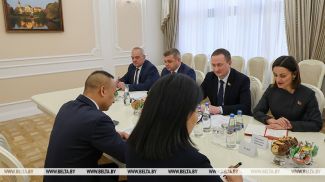
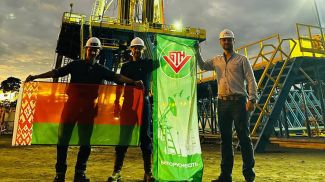
Like many other enterprises in the industry, we are tackling the challenge of significantly diversifying our export supplies. Traditionally, the key export market for Amkodor was the Russian Federation, but since last year the situation has begun to change. We have received good orders from Latin America, and by the second half of this year we expect to conclude large contracts with several African states.
The export structure will undergo significant changes. We are striving for the 30-30-30 formula - a balanced presence across three key directions.
For us, the African region essentially represents new countries - we haven’t worked there for about two decades. Some countries, such as Zimbabwe and Nigeria, are traditional partners of Belarus overall, but for Amkodor this is a new direction. We are also actively working on entering the markets of Algeria, Egypt, and other African states.
What machinery is most in demand on the African market?
We are covering a wide range. First and foremost, it’s traditional road construction equipment - loaders, excavators, bulldozers, graders, rollers, and backhoe loaders on our own chassis and on MTZ chassis.
Experience studying the African region has shown that forestry machinery is also in demand there, though it needs to be adapted to local climatic conditions and the specific characteristics of the harvested material.
A key direction is addressing food security challenges, which means supplying agricultural machinery - from soil cultivation to post-harvest processing and grain storage systems. Virtually the entire range of agricultural machinery, except for tractors and combines, is represented in our group of companies and is in demand on the continent.
Tell us about your latest machinery, especially in the forestry sector.
Our plans are ambitious. Speaking about the forestry industry, we are already launching serial production of compact timber-harvesting machines designed for sanitary and thinning cuts. These models are capable of replacing previously imported Western analogues. The machines were developed jointly with the Belarusian Forestry Ministry.
We have also approved the development of a new mid-class harvester with a 4×4 wheel formula for industrial logging – a highly demanded machine for Belarusian forests. We expect to complete the design work this year.
For the Russian market, we are actively preparing heavy-class 8×8 machines for serial production, equipped with key components of our own manufacture. These are fully import-substituted forestry machines fitted with Amkodor’s component base: axles, manipulators, harvester heads, and control systems. We are finalizing prototype production and testing, and serial manufacturing will begin in the second quarter. Production will also be located at our Amkodor Onego facility in Karelia.
What new products are planned in other segments?
In the road-construction segment, we are launching serial production of 800-kg mini-loaders, a class of machines we did not produce before. We are completing tests of seven-tonne loader models, and our lineup will also be expanded with 5.5-tonne machines.
As for utility machines, we are finalizing preparations for the production of the VU-8 universal compact machine with a wide range of interchangeable attachments unified with other Amkodor equipment. This solution allows a single set of attachments to meet the needs not only of municipal services but also of agricultural enterprises and the road-construction industry.
We also have large-scale plans for land-reclamation machinery, which can also be used in road construction. We plan to launch production of a 16-tonne wheeled excavator and are completing tests and preparing for production of a 25-tonne crawler excavator and bulldozer, which will complement our existing lineup. We are actively expanding our range of road, soil, and combined rollers, which will allow us to enter new market niches.
In the agricultural sector, this year we plan to manufacture and test a prototype of a self-propelled feed mixer-distributor: a unique machine with no analogues in the post-Soviet space. It will significantly improve the efficiency and quality of cattle feeding operations. We are also expanding our range of trailed fertilizer spreaders.
How dependent is the company on imported components?
We are actively developing our own component base: axles, gearboxes, cabins, lighting equipment, controllers, and control systems with proprietary software. This allows us to achieve a production localization level of around 70% within the holding. And if we consider the Union State of Belarus and Russia, localization for a number of machines approaches 100%.
Our strategy is to be independent from imports and to work ahead of the curve, incorporating our own or Union State component base into our design solutions. In extreme cases we use components from friendly countries, primarily China.
Does Amkodor meet the needs of the domestic market?
Today we are ready to fully meet the needs of the domestic market for virtually our entire product range. Our capacity significantly exceeds the current demand. In last year’s sales structure the domestic market accounted for about half and export accounted for the other half.
What steps is the holding company taking in the area of sustainable development and ecology?
Like many industrial enterprises we strive to improve the environmental situation both in manufacturing and in operating our equipment. We work to continuously improve the environmental class of our products by using modern engines in collaboration with our key partner Minsk Motor Plant.
The electric transport sector is actively developing, including electric forklifts, electric trucks, and special vehicles. We are examining the possibility of converting other types of Amkodor special vehicles to electric transmission. We understand that this requires infrastructure, but we are laying the groundwork for the future, bearing in mind the development of the country’s electric power potential.
We are also converting the heating systems of our enterprises to electric sources instead of combustible heat transfer agents. All new modernization projects initially provide for the use of electricity as the most environmentally friendly energy source.
How closely does the holding company cooperate with scientific organizations?
We work closely with the State Committee on Science and Technology, the National Academy of Sciences of Belarus, and its industry-specific institutes such as the Joint Institute of Mechanical Engineering, the Physical-Technical Institute, the Institute of Technology of Metals, and other ones. Apart from that, we have branches of departments of leading technical universities: BNTU, BSUIR, BSATU, and other ones. We try to work with young people literally from the university bench, providing practice-oriented training for future personnel.
How do you attract young people to the company’s enterprises? Is the staffing problem relevant?
The staffing situation at our enterprises, as in the country as a whole, is quite tense. This is why work in this direction is carried out systematically. We conduct career guidance events with secondary school students, telling them about the prestige of blue-collar professions, which today require high competencies. Modern equipment – CNC machines, robotic systems – often requires not just secondary specialized education, but very often higher education.
One of our key activities meant to raise the prestige of blue-collar professions is the project “Children are the future of Amkodor”. We invite children of our employees from all the holding’s enterprises to Minsk, organize tours of the workplaces, and hold themed contests. The interactive format leaves the children with vivid impressions of the enterprise and, we hope, fosters an interest in industrial professions.
At the same time, we understand that human resources are not the only solution. This is why we are actively engaged in increasing the robotization and automation of manufacturing processes. New robotic complexes are currently being introduced at enterprises in Minsk and similar tasks have been set for plants in Kokhanovo, Pinsk, and Molodechno. A significant level of robotization has already been achieved at plants in Logoisk and Dzerzhinsk.