
Image credit: vitvesti.by
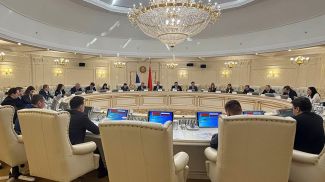
MINSK, 29 December (BelTA) – The results of the social and economic development of Vitebsk Oblast over the past five years were reviewed at a session of the Vitebsk Oblast Council of Deputies, BelTA has learned.
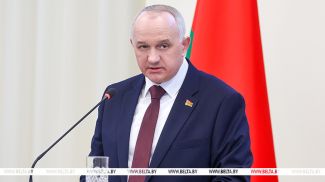
During the past five-year period, the work of the Vitebsk Oblast Executive Committee, in cooperation with the deputies and executive committees of cities and districts, was primarily aimed at ensuring the stable operation of the real economy, boosting investment activity, and improving the standard and quality of life of the population. As noted by Chairman of the Vitebsk Oblast Executive Committee Aleksandr Subbotin, the region’s economy withstood all the challenges it faced and proved its resilience. “We managed to reverse negative trends and ensure growth in key regional development parameters: gross regional product (up 2.1% compared to 2020), industrial production volumes excluding oil refining and energy (up 11.3%), livestock production (up 1.8%), retail and wholesale trade (up 18.1%), as well as in public catering, passenger traffic, investments, and export of goods and services. Over the five years, organizations in the region achieved a 1.6-fold increase in revenue and a 1.5-fold increase in profit from sales,” Aleksandr Subbotin said.
According to him, the region’s investment indicators are at a record high. “Over 60% of investments are in real production. We have been investing over Br4 billion annually into the economy and production for three years now. And this is perhaps the most important indicator. It translates into factories being built, new jobs and products being created, and export contracts being signed. The payoff from these investments will be seen in 2-3 years, which is why the future looks promising,” the head of the region emphasized.
Aleksandr Subbotin added that more than 190 investment projects have been implemented in the real economy, one-third of them in small and medium-sized settlements. Approximately 2,500 new jobs have been created. The investment volume over the five-year period exceeded Br9.5 billion. There is an active drive to put idle assets back into use. In the past five years, the region has reintegrated 1,140 properties into its economic turnover, 37 of which are earmarked for investment projects. Under the agreement between the Republic of Belarus and the Russian Federation, integration projects utilizing Russian financial credit are being implemented at OAO Vistan, OAO Machine Tool Plant Krasny Borets, and OAO BelAZ. OOO Gidropress participates in a cooperative project for the construction of a high-speed railway, utilizing the financial assistance mechanism for industrial cooperation funded by the EAEU budget.
“In line with the directive One District - One Project of the head of state, a pool of 35 projects has been formed. Eighteen have already been completed, creating 485 new jobs. Projects have been implemented for the production of food flavorings in Beshenkovichi, lubricants in Glubokoye District, electrical products in Braslav District, perfumery and garment products in Dokshitsy District, fish products in Chashniki District, fruit and vegetable juice and nectar in Sharkovshchina District, modernization of the woodworking production at the Berezinsky Biosphere Reserve in Lepel District, implementation of metal structure production technology based on Industry 4.0 by the Novopolotsk Plant of Technological Metal Structures, organization of new product types production at the Obol Ceramic Plant, and dairy product output at the Postavy Dairy Plant. Another 7 projects are in the final stage and will be completed by the end of the year,” Aleksandr Subbotin said.
Speaking about agricultural development, he noted that despite two very unsuccessful recent years with droughts, and spring frosts, farmers achieved positive results over the 5-year period. “Overall growth in the sector is almost 2%. Over Br3.2 billion, or 20% of the region’s investments, were allocated for technical re-equipment and modernization of agriculture in the current five-year period. Twenty-one dairy complexes have been commissioned, 2 pig breeding farms have been built, 15 pig farming facilities have been renovated, and 4,000 units of agricultural machinery have been purchased. Vitebsk Broiler Poultry Farm alone invested over half a million rubles in its development,” Aleksandr Subbotin said.
During the past five-year period, the work of the Vitebsk Oblast Executive Committee, in cooperation with the deputies and executive committees of cities and districts, was primarily aimed at ensuring the stable operation of the real economy, boosting investment activity, and improving the standard and quality of life of the population. As noted by Chairman of the Vitebsk Oblast Executive Committee Aleksandr Subbotin, the region’s economy withstood all the challenges it faced and proved its resilience. “We managed to reverse negative trends and ensure growth in key regional development parameters: gross regional product (up 2.1% compared to 2020), industrial production volumes excluding oil refining and energy (up 11.3%), livestock production (up 1.8%), retail and wholesale trade (up 18.1%), as well as in public catering, passenger traffic, investments, and export of goods and services. Over the five years, organizations in the region achieved a 1.6-fold increase in revenue and a 1.5-fold increase in profit from sales,” Aleksandr Subbotin said.
According to him, the region’s investment indicators are at a record high. “Over 60% of investments are in real production. We have been investing over Br4 billion annually into the economy and production for three years now. And this is perhaps the most important indicator. It translates into factories being built, new jobs and products being created, and export contracts being signed. The payoff from these investments will be seen in 2-3 years, which is why the future looks promising,” the head of the region emphasized.
Aleksandr Subbotin added that more than 190 investment projects have been implemented in the real economy, one-third of them in small and medium-sized settlements. Approximately 2,500 new jobs have been created. The investment volume over the five-year period exceeded Br9.5 billion. There is an active drive to put idle assets back into use. In the past five years, the region has reintegrated 1,140 properties into its economic turnover, 37 of which are earmarked for investment projects. Under the agreement between the Republic of Belarus and the Russian Federation, integration projects utilizing Russian financial credit are being implemented at OAO Vistan, OAO Machine Tool Plant Krasny Borets, and OAO BelAZ. OOO Gidropress participates in a cooperative project for the construction of a high-speed railway, utilizing the financial assistance mechanism for industrial cooperation funded by the EAEU budget.
“In line with the directive One District - One Project of the head of state, a pool of 35 projects has been formed. Eighteen have already been completed, creating 485 new jobs. Projects have been implemented for the production of food flavorings in Beshenkovichi, lubricants in Glubokoye District, electrical products in Braslav District, perfumery and garment products in Dokshitsy District, fish products in Chashniki District, fruit and vegetable juice and nectar in Sharkovshchina District, modernization of the woodworking production at the Berezinsky Biosphere Reserve in Lepel District, implementation of metal structure production technology based on Industry 4.0 by the Novopolotsk Plant of Technological Metal Structures, organization of new product types production at the Obol Ceramic Plant, and dairy product output at the Postavy Dairy Plant. Another 7 projects are in the final stage and will be completed by the end of the year,” Aleksandr Subbotin said.
Despite challenging conditions in foreign trade, Vitebsk Oblast managed to preserve sales markets, increase supplies to new ones, and ensure their diversification. “Today, products with the Vitebsk brand are supplied to 70 countries worldwide. The main trading partner remains the Russian Federation, with trade increasing 1.6-fold. Markets in the Middle East and Southeast Asia are being developed. Supplies of goods to Iran, Iraq, and India have increased many times over. Over the five years, supplies to China have doubled,” Aleksandr Subbotin stated.
Speaking about agricultural development, he noted that despite two very unsuccessful recent years with droughts, and spring frosts, farmers achieved positive results over the 5-year period. “Overall growth in the sector is almost 2%. Over Br3.2 billion, or 20% of the region’s investments, were allocated for technical re-equipment and modernization of agriculture in the current five-year period. Twenty-one dairy complexes have been commissioned, 2 pig breeding farms have been built, 15 pig farming facilities have been renovated, and 4,000 units of agricultural machinery have been purchased. Vitebsk Broiler Poultry Farm alone invested over half a million rubles in its development,” Aleksandr Subbotin said.