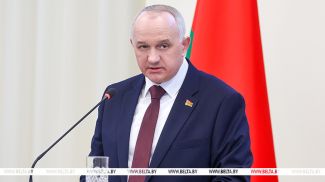

Natalya Petkevich. Photo courtesy of the EEC
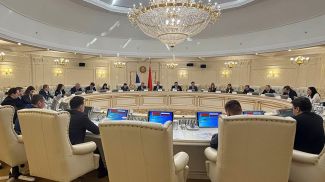
MOSCOW, 30 January (BelTA) - The Council of the Eurasian Economic Commission (EEC) has begun implementing the roadmap for the Declaration on the Further Development of Economic Processes within the Eurasian Economic Union until 2030 and for the Period until 2045, titled the Eurasian Economic Path. The declaration was approved last year during Belarus’ presidency in the EAEU bodies, Belarusian Deputy Prime Minister Natalya Petkevich told the media following the EEC Council meeting in Moscow on 30 January, BelTA has learned.
According to Natalya Petkevich, during the Belarusian chairmanship the foundations were laid for further expansion of the EAEU’s external engagement. “Today we have approved the pool of countries with which the EAEU will begin negotiations on a preferential trade regime and the creation of free trade zones. We have approved the priority countries for starting negotiations: these are Zimbabwe, Jordan, Pakistan, and South Africa,” she said.
The EEC Council additionally backed several Belarusian proposals to lower or remove import duties on specific raw commodities. “They are crucial for cutting production expenses and the final cost of our goods, or for securing supplies of items that are scarce or not produced domestically,” the vice premier explained. “For instance, this includes cocoa beans, cocoa fats, and cocoa butter, which are essential for our confectionery sector.”
Natalya Petkevich also noted that a mechanism for financial support of industrial cooperation projects is operational within the EAEU. “Today, a decision was made to extend this program to projects in the agro-industrial complex as well, which, overall, also took quite a lengthy procedure to coordinate all positions. But today we adopted that decision,” the deputy prime minister said.
According to Natalya Petkevich, during the Belarusian chairmanship the foundations were laid for further expansion of the EAEU’s external engagement. “Today we have approved the pool of countries with which the EAEU will begin negotiations on a preferential trade regime and the creation of free trade zones. We have approved the priority countries for starting negotiations: these are Zimbabwe, Jordan, Pakistan, and South Africa,” she said.
The EEC Council additionally backed several Belarusian proposals to lower or remove import duties on specific raw commodities. “They are crucial for cutting production expenses and the final cost of our goods, or for securing supplies of items that are scarce or not produced domestically,” the vice premier explained. “For instance, this includes cocoa beans, cocoa fats, and cocoa butter, which are essential for our confectionery sector.”
Natalya Petkevich also noted that a mechanism for financial support of industrial cooperation projects is operational within the EAEU. “Today, a decision was made to extend this program to projects in the agro-industrial complex as well, which, overall, also took quite a lengthy procedure to coordinate all positions. But today we adopted that decision,” the deputy prime minister said.