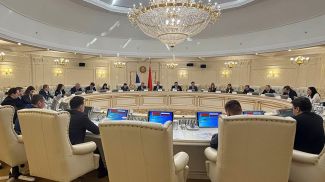
MINSK, 25 October (BelTA) – We should avoid a formalistic approach to the preparation of the CIS future development concept and the CIS economic development strategy until 2030, Belarus Prime Minister Sergei Rumas said as he addressed the CIS summit in Moscow on 25 October, BelTA learned from the press service of the government.
“In fact, the CIS future development concept and the CIS economic development strategy for the period up to 2030 have been drafted and are ready. The groups of experts are now working on the plans of action to implement them. These are big documents affecting all areas of joint activity for the next decade. Therefore, there should be no formalistic approach to preparing them,” Sergei Rumas noted.
The head of government proposed to involve CIS sectoral agencies to this work. “In our view, each area should be carefully worked out and filled with practical content in the form of projects and activities," he said.
Sergei Rumas noted that digital transformation has a serious potential for economic development. In the very near future it will affect the entire architecture of social and economic relations, and not only within each country but also at the interstate level. In this regard, he suggested signing a concept of cooperation in the field of digital development of society and a plan of priority measures to implement it.
“The signing of another important document, namely the information security strategy will, in turn, contribute to interstate digital cooperation and increase mutual trust in the information sector. The main task now is to develop concrete effective mechanisms of practical cooperation between the relevant bodies of our countries,” Sergei Rumas said.
The prime minister emphasized the need for closer cooperation between the CIS Executive Committee and the Eurasian Economic Commission in order to synchronize digital processes in the CIS and the EAEU. According to him, if the countries do not move in sync in the digital agenda, there will be a digital gap. “The systems will not be able to interact with each other. To prevent this from happening, we need to forge close cooperation between the Executive Committee and the Eurasian Economic Commission to synchronize digital processes in the EAEU and the CIS. I think it is important for the CIS Executive Committee and the EEC to work more closely in many other areas related to mutual trade and economic cooperation,” said the Belarusian head of government.
He stressed that the principle of multilevel and multi-speed integration should be applied properly in order to avoid any "watersheds" in the CIS in connection with the participation of the member states in various integration formats.
Sergei Rumas also emphasized the need to secure a barrier-free environment for the movement of goods in the CIS. According to him, it will rev up regional trade. “This requires additional leverage. I can say that the implementation of the free trade zone agreement, namely the provision of a barrier-free environment for the movement of goods in the CIS market, is of particular importance here. I suggest the CIS Interstate Council for Standardization, Metrology and Certification analyze the situation with the technical barriers in the free trade zone, draw up the proposals on their elimination and submit them for the next meeting of the council,” he said.
According to the Belarusian head of government, the drafting of an agreement on free trade in services will contribute to more vibrant trade relations. The prime minister said that the search for new common points of growth in the domestic market is necessitated by external factors that limit export opportunities of the countries. “These includethe recent slowdown in global economic growth, as well as trade wars and increased economic risks due to the deteriorating international situation. Unfortunately, these processes had a negative impact not only on the trade relations between the CIS member states and third countries but also the trade within the CIS,” he said.