
MINSK, 16 December (BelTA) – Chairman of the Board of the National Bank of the Republic of Belarus (NBRB) Roman Golovchenko talked to reporters on 16 December and gave a brief overview of the main monetary management guidelines, which had been passed by the NBRB Board earlier that day, BelTA has learned.
Roman Golovchenko said: “To maintain price stability, we will, of course, control the growth of the money supply. The head of state has also drawn attention to this, which is why the National Bank will use all the tools at its disposal. It is important to note that the money supply should be formed at a level that ensures both steadily low inflation and the satisfaction of the economy’s solvent demand for money. According to our estimates, the money supply will increase by 10-12% next year. The Belarusian ruble exchange rate will remain floating. In other words, it will continue to depend solely on currency supply and demand on the domestic market.”
The key areas of activity of the National Bank will also include regulating the operation of commercial banks, of other financial institutions in the country, and of the financial market in addition to ensuring the smooth operation of payment systems and the payment market. “One of the most important tasks in this area is to strike a balance between limiting risks to financial stability and maintaining the availability of loans for the real sector of the economy. The focus will be on maintaining the quality of the loan portfolios of banks and non-bank organizations as well as their work with enterprises to reduce problem debts, the level of credit burden on households, on strengthening the protection of consumers of financial services, improving the financial literacy of the population, and measures taken by banks to ensure information security and prevent fraud,” said the NBRB Board chairman.
The National Bank will continue to work actively with banks to develop the payment infrastructure and non-cash retail payments, including by optimizing commission fees. “It has already been announced and I will repeat once again that in the near future we will make a decision to expand the list of free services provided by banks, primarily to individuals, and to limit the size of commission fees charged by banks for transactions in order to ensure that they are all economically justified and reasonable,” said Roman Golovchenko.
Ensuring price and financial stability is the foundation for the country’s sustainable economic development. “This is why next year massive work is being planned to increase the financial sector’s involvement in supporting our country’s economic development. Banks will be encouraged to satisfy the economy’s solvent demand as much as possible. According to our estimates, banks’ demands on the economy will grow by 9% to 11%, which is sufficient to meet the GDP growth target. At the same time, interest in attracting financial resources through leasing agreements is expected to persist. As for the provision of financial resources, just like this year, our focus will be on supporting businesses. First and foremost, those which are actively modernizing their manufacturing facilities, those which produce export and import-substituting goods, as well as small and medium-sized businesses. It means that every bank should be focused on fulfilling the task set by the president to increase investment financing. This direction will also remain a priority for the next year. As for the cost of borrowed funds, no increase is expected. Interest rates on new market loans in the national currency are projected at 11.5-14% while banks will continue to focus on setting lower interest rates on investment loans. According to the projections, it will range from 10% to 12% per annum on average through 2026,” said the head of the National Bank.
The National Bank will also continue focusing on the development of partnership programs between banks and Belarusian manufacturers and on the issuance of consumer loans for purchasing domestically produced goods.
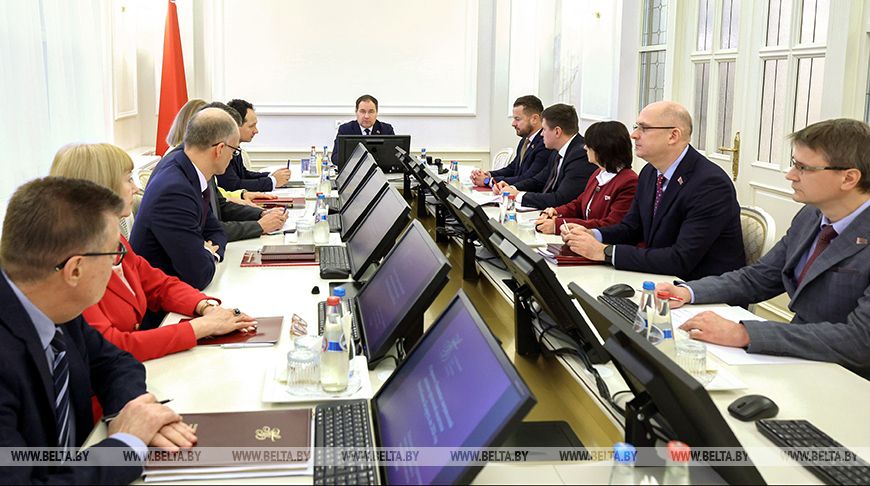
The banking system will also face the task of forming a reliable resource base to meet the needs of the economy. “What needs to be done to achieve that? Certainly, we will need to increase the inflow of so-called long money into the economy, In other words, money deposited with the banking system by individuals and legal entities. First and foremost, these are fixed-term irrevocable deposits in Belarusian rubles with the maturity of more than one year. We believe that this task has been successfully accomplished in the current year of 2025. We see steady confidence, primarily among our citizens, in long-term savings with the maturity of more than one year. We endeavor to move on to the next stage, which is to create conditions for attracting deposits for a period of three years and longer,” said the NBRB Board chairman.
“We will maintain the continuity of the policy we’ve pursued this year. The National Bank does not expect any drastic changes on the currency market and the financial market. This is why we will continue to work calmly within the parameters we have set. All the parameters adopted today as part of the main monetary management guidelines are fully consistent with the objectives stipulated by the draft program on the country’s social and economic development for the next five-year term. I am confident that we will be able to create the necessary macroeconomic conditions to achieve the objectives set by the program,” concluded Roman Golovchenko.