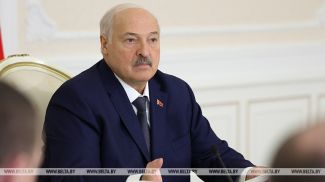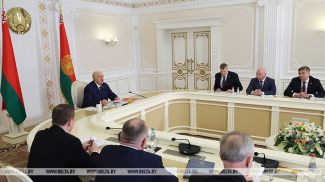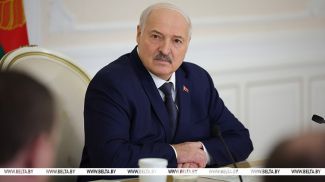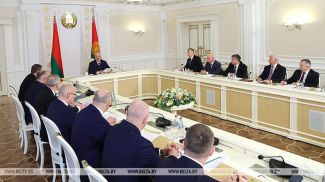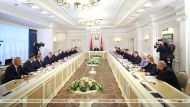

MINSK, 12 March (BelTA) - The draft decree on procurement issues and the elimination of unjustified and unfair intermediation will be finalized and submitted for consideration to the president of Belarus in mid-April 2026, Deputy Chairman of the Belarusian People’s Congress Aleksandr Kosinets told the media following the meeting with the head of state on 12 March, BelTA has learned.
Recently, Aleksandr Kosinets, leading a group of specialists, had been
working on relevant issues at the president’s instruction. The result
was a draft decree, which was reviewed at the meeting with the head of
state. It proposes a number of measures to improve the existing
regulatory framework.
“The existing legislative framework, the measures taken by the government, resolutions, and plans are working to a certain extent. But at the same time, they are not producing the desired result because our social and economic development is suffering huge damage as a result of unfair intermediation,” he said. “The head of state has set the task of preparing a comprehensive decree on urgent measures to eliminate unfair and unjustified intermediation by 15 April.”
The document will include several areas of focus. First of all, legislative aspects need to be adjusted. “We need to seriously revise the 2012 law on procurement, supplement it, and substantially reconsider the organizational issues related to its implementation,” Aleksandr Kosinets said.
“The existing legislative framework, the measures taken by the government, resolutions, and plans are working to a certain extent. But at the same time, they are not producing the desired result because our social and economic development is suffering huge damage as a result of unfair intermediation,” he said. “The head of state has set the task of preparing a comprehensive decree on urgent measures to eliminate unfair and unjustified intermediation by 15 April.”
The document will include several areas of focus. First of all, legislative aspects need to be adjusted. “We need to seriously revise the 2012 law on procurement, supplement it, and substantially reconsider the organizational issues related to its implementation,” Aleksandr Kosinets said.

He explained that the provisions of the current law apply only to state procurement, not to procurement financed from the own funds of organizations and enterprises. Meanwhile, 90% of all corruption-related manifestations and violations in the procurement sector are detected precisely when payment is made using own funds.
“We will pay the closest attention to the gaps that exist in the legislation,” the deputy chairman of the Belarusian People’s Congress emphasized.
Another area is organizational measures, concerning primarily the updating and maintenance of a catalog of works and services. The current version is outdated. A corresponding catalog is needed to see on a daily basis what opportunities and offers are available on the market, and to avoid paying exorbitant prices to unfair intermediaries.
Aleksandr Kosinets also drew attention to the aspect that sometimes intermediation stems from the consumer themselves, who may be in collusion with the supplier. “We will pay close attention to this issue. And also to the register of unfair intermediaries, with whom we should have absolutely no relations and not allow into our market,” he said.
The draft decree will also include measures in the financial and economic sector aimed at eliminating unjustified intermediation. As well as a number of other measures concerning import issues and personal responsibility.
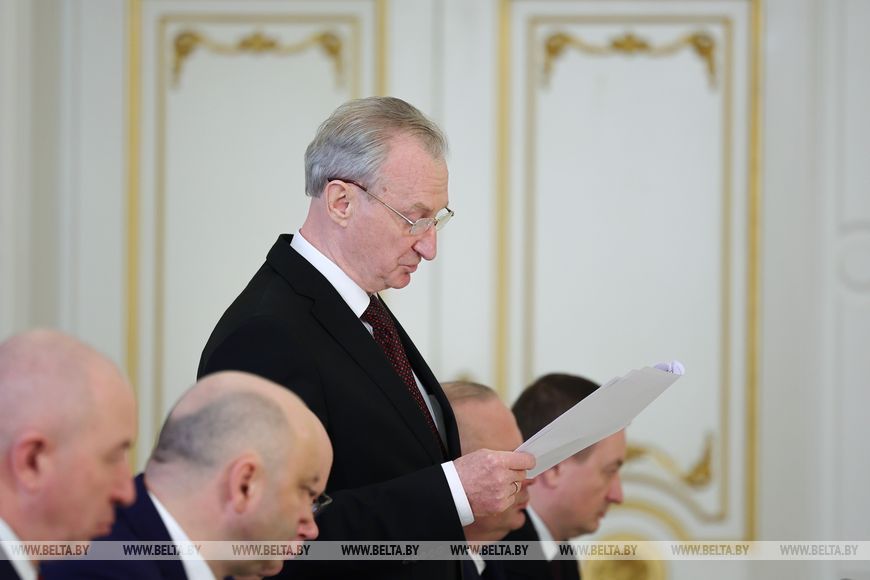
“Ultimately, it will bring enormous benefits and provide a tangible effect for the social and economic development of Belarus. After all, the increase in production costs [as a result of unjustified intermediation] falls on the pockets of citizens and reduces the competitiveness of goods. By 15 April, the document will be prepared and placed on the President’s desk,” Aleksandr Kosinets summarized.
A separate issue at the meeting with the head of state was the draft decree on centralizing the procurement of certain goods for agriculture. The president expressed the view that the list of products to be centrally procured for agriculture should be expanded. Following the meeting, it was decided to incorporate the provisions of this decree into a single comprehensive document, as reported to journalists by Agriculture and Food Minister Yuri Gorlov.
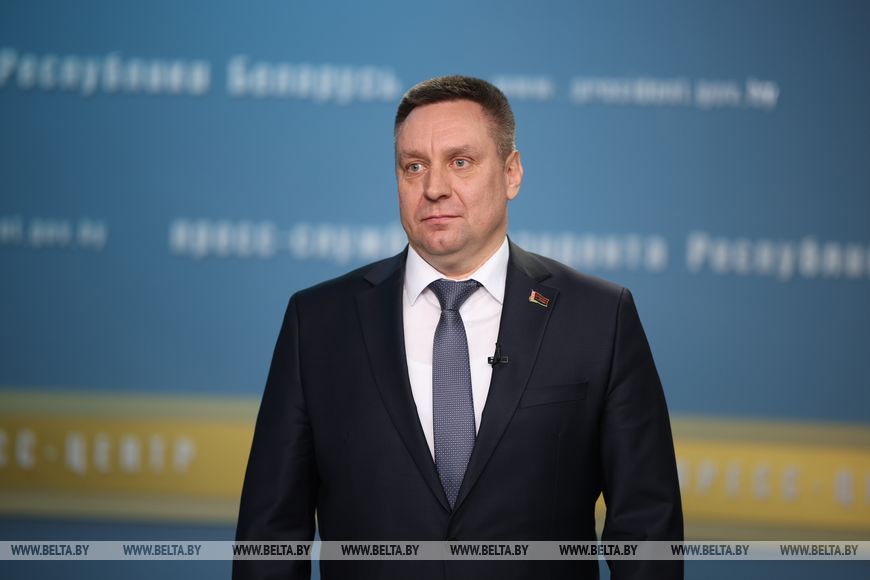
The agriculture and food minister noted that unjustified intermediation leads to a significant increase in goods prices. He cited herbicides and machinery spare parts as examples. The inflated price ultimately leads to an increase in the cost of domestic products. “The price of the same product, in the same volume and with the same delivery terms, differs by more than two times. That is regarding plant protection products. When it comes to spare parts, prices differ by five or six times. Of course, this is unacceptable and affects the cost of our products,” Yuri Gorlov emphasized.
The decree, which will be submitted for consideration to the president, will significantly reduce the cost of products, including in agriculture, the agriculture and food minister believes. “For our industry, for food producers, this is very relevant. We are an export-oriented country, and the cost of manufactured products needs to be reduced,” he said. “We sell dairy and meat products for export and see how the cost of specific products is shaped in various countries. In this regard, we have reserves.”
This regulatory legal document will become a kind of instruction that will ensure much greater transparency in procurement. At the same time, Yuri Gorlov added, our producers, buyers, and sellers should not be placed in a rigid framework. “There should be a certain flexibility. But everything should be transparent, open, and accessible,” the minister said.
“We will pay the closest attention to the gaps that exist in the legislation,” the deputy chairman of the Belarusian People’s Congress emphasized.
Another area is organizational measures, concerning primarily the updating and maintenance of a catalog of works and services. The current version is outdated. A corresponding catalog is needed to see on a daily basis what opportunities and offers are available on the market, and to avoid paying exorbitant prices to unfair intermediaries.
Aleksandr Kosinets also drew attention to the aspect that sometimes intermediation stems from the consumer themselves, who may be in collusion with the supplier. “We will pay close attention to this issue. And also to the register of unfair intermediaries, with whom we should have absolutely no relations and not allow into our market,” he said.
The draft decree will also include measures in the financial and economic sector aimed at eliminating unjustified intermediation. As well as a number of other measures concerning import issues and personal responsibility.
“Ultimately, it will bring enormous benefits and provide a tangible effect for the social and economic development of Belarus. After all, the increase in production costs [as a result of unjustified intermediation] falls on the pockets of citizens and reduces the competitiveness of goods. By 15 April, the document will be prepared and placed on the President’s desk,” Aleksandr Kosinets summarized.
A separate issue at the meeting with the head of state was the draft decree on centralizing the procurement of certain goods for agriculture. The president expressed the view that the list of products to be centrally procured for agriculture should be expanded. Following the meeting, it was decided to incorporate the provisions of this decree into a single comprehensive document, as reported to journalists by Agriculture and Food Minister Yuri Gorlov.
The agriculture and food minister noted that unjustified intermediation leads to a significant increase in goods prices. He cited herbicides and machinery spare parts as examples. The inflated price ultimately leads to an increase in the cost of domestic products. “The price of the same product, in the same volume and with the same delivery terms, differs by more than two times. That is regarding plant protection products. When it comes to spare parts, prices differ by five or six times. Of course, this is unacceptable and affects the cost of our products,” Yuri Gorlov emphasized.
The decree, which will be submitted for consideration to the president, will significantly reduce the cost of products, including in agriculture, the agriculture and food minister believes. “For our industry, for food producers, this is very relevant. We are an export-oriented country, and the cost of manufactured products needs to be reduced,” he said. “We sell dairy and meat products for export and see how the cost of specific products is shaped in various countries. In this regard, we have reserves.”
This regulatory legal document will become a kind of instruction that will ensure much greater transparency in procurement. At the same time, Yuri Gorlov added, our producers, buyers, and sellers should not be placed in a rigid framework. “There should be a certain flexibility. But everything should be transparent, open, and accessible,” the minister said.