Ivye is known as the city of four faiths: Catholic, Orthodox, Muslim, and Jewish. It is also the Mecca of Belarusian Tatars. This district center in Grodno Oblast is home to a unique mosque. Founded over 140 years ago, it has been recognized as the spiritual center of Muslims in Belarus. We visited this place of worship, learned about its history, Islamic traditions, and the changes since it gained special status.
Oldest active mosque
Muslims perform five daily prayers, usually all at home, except on Fridays and holidays. We arrived in the Tatar Sloboda as the morning ritual prayer was concluding. We walked through the well-kept courtyard of the Ivye Mosque, where numerous cedars. In the center of the courtyard stands a wooden prayer house in the Art Nouveau style, a minaret with a tall spire, and a gallery. Awaiting us is Imam Adam Radetsky.
“The Ivye Mosque is the oldest functioning mosque on the territory of Belarus. It was built between 1882 and 1884. The construction was financed by Countess Elfrieda Zamoyska, a local landowner, a Catholic by faith. She allocated money for the purchase of timber," Adam Radetsky said introducing us to the history of the Muslim shrine in Ivye.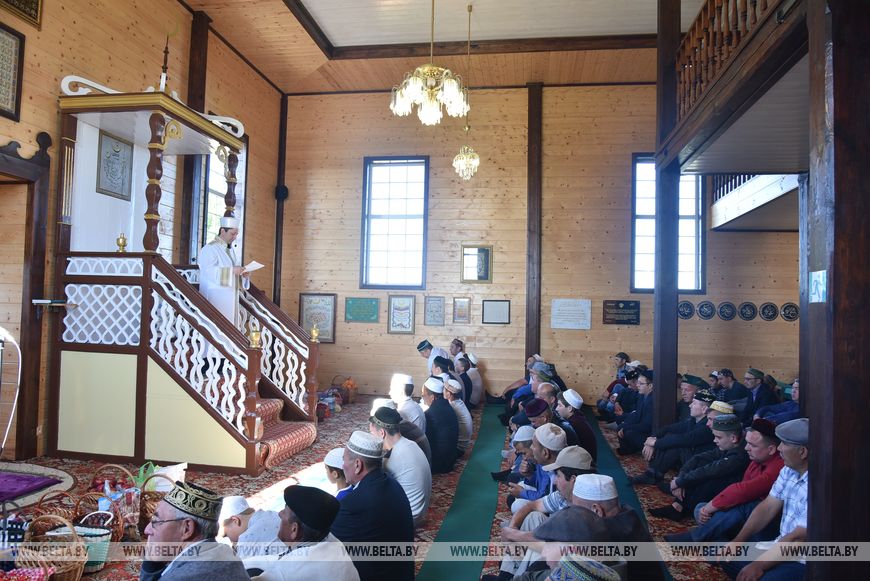 Initially, the mosque was rather modest, not much different from the other buildings in the Tatar Sloboda. At that time, in the heart of Europe, it was difficult to obtain permission to build a place of worship for Muslims.
An important fact is that the Ivye Mosque has never been closed: neither during the years of Soviet anti-religious policies nor during the German occupation. The building of this temple miraculously escaped destruction, but like any wooden structure, it required significant repairs. From 2014 to 2017, the Ivye Mosque underwent extensive restoration, bringing its appearance as close as possible to its historical early 20th-century look. The restoration was based on a single old photograph from World War I, taken by a soldier with the mosque in the background. As the imam noted, the building was restored through a collective, community-wide effort.
Descendants of valiant warriors
The history of the mosque is closely tied to the arrival of Tatars in Belarus, who settled in these lands as early as the 14th–15th centuries. It was these valiant warriors of the Golden Horde whom the dukes of the Grand Duchy of Litva (Lithuania) began inviting into their service to guard the borders of the Grand Duchy of Litva (Lithuania) against the Teutonic Order.
The first Tatars settled in Ivye when Grand Duke Vitaut granted them small plots of land in gratitude for their participation in the Battle of Grunwald, where the decisive victory over the army of the Teutonic Order was achieved. In addition to the warriors of the Grand Duchy of Litva (Lithuania), the local community also integrated captured Tatars and refugees from Crimea. As time went by, the Tatars gradually assimilated with the local inhabitants. Today, around 500 descendants of ancient Tatar clans live in Ivye. Every year, Muslims from various parts of Belarus and even from abroad come here for Eid al-Adha and Eid al-Fitr to participate in the prayer. The Ivye Mosque has become a religious center not only for the local Tatars.
Call to prayer
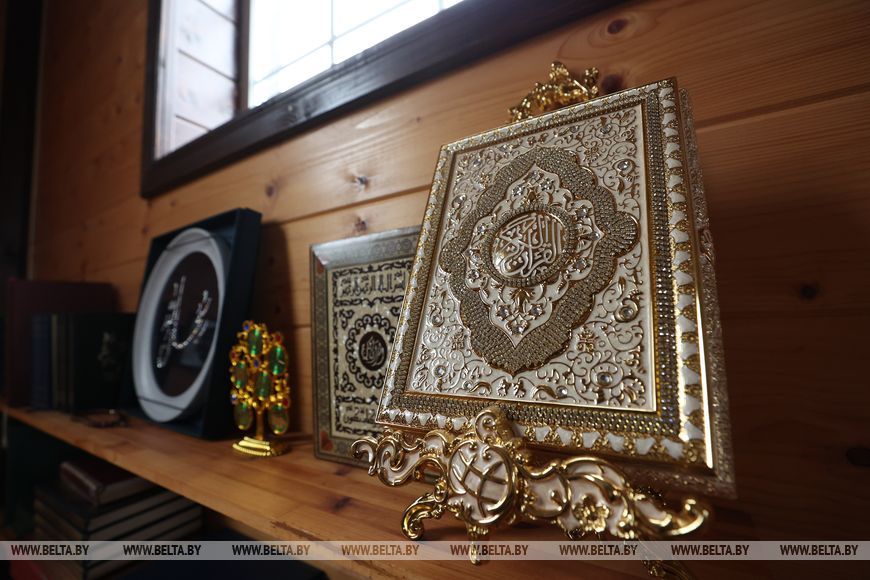
Adam Radetsky leads us into the heart of the mosque – its main prayer hall. It is here that men gather to pray on Fridays and festive days. After taking off our shoes, we step inside the spacious room, its floor covered with a soft, warm carpet. At the heart of it, atop the elevated minbar, the ceremonial pulpit, rest several Qurans, one of them housed in an ornate, gilded casing. Following tradition, Adam Radetsky takes his place at the front of the congregation, oriented toward Mecca. Behind him are the men who can recite prayers in Arabic. Against the back wall of the prayer hall are benches where an elderly person or a guest, even a non-Muslim, can sit. Women pray in their designated section. While in countries with large Muslim populations, people are called to prayer through special loudspeakers installed on the minaret by a muezzin, in Ivye, invitations are sent via messengers and by phone.
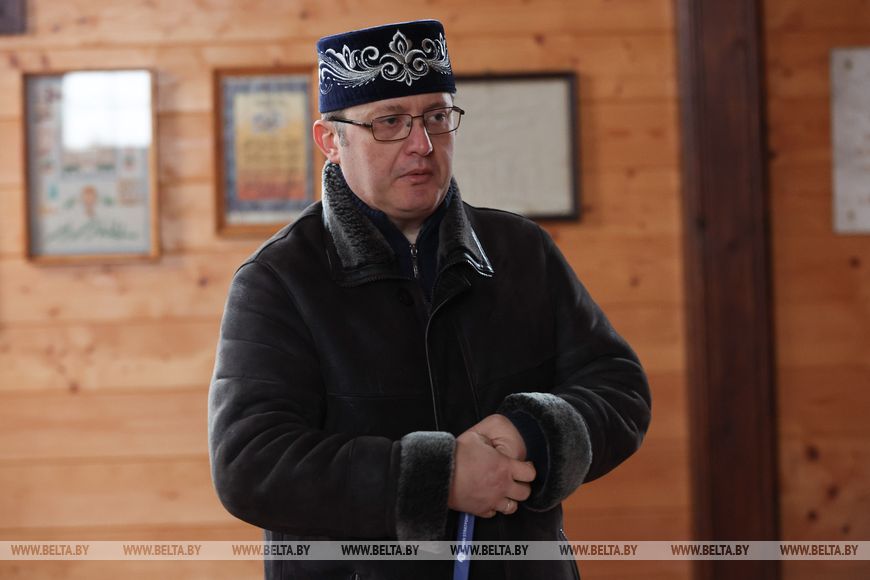
The main services in the mosque are conducted in two languages: Arabic and Russian. Importantly, the mosque serves not only a religious but also an educational mission. Children are taught Arabic here and introduced to the basics of Islam.
After the Ivye Mosque received the status of a spiritual center of Islam, it began hosting talks with tourists, who most often visit this district center on weekends from Grodno and Minsk.
“On Fridays, between 50 and 70 people come to the mosque,” Adam Radetsky says, adding that on festive days, up to 300 people aged 40 and above may gather. Some bring their children, who already know how to behave during prayer.
Guidebooks of faith
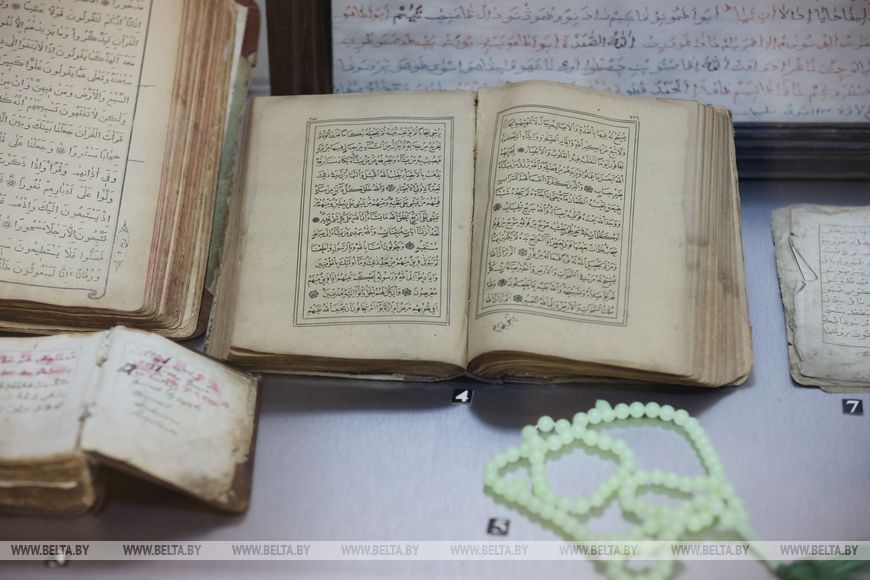
On weekdays, believers pray at home using hamails (small books) containing daily prayers, selected surahs from the Quran, instructions, and religious rituals. These are kind of spiritual guidebooks for the Tatar family. They learn Arabic from childhood, and many of them have written their khamails for home prayers in Arabic as well as in Russian and Belarusian. It is noteworthy that they have managed to partially preserve their culture and religion, but not their language. That is why, according to scholars, local khamails are of particular value to the history of Belarus and traditional Islam in our land.
Adam Radetsky is not the first imam in his line. His grandfather Ibragim was a spiritual leader of the community in the village of Dovbuchki in Smorgon District, not far from Kreva Castle in the 19th century and his grandmother’s brother Suleiman was a spiritual leader of the community in Krushinyany in Eastern Poland in the 20th century.
Adam Radetsky was initially taught Arabic by local elders. After that he continued his studies in Türkiye, taking special Koran courses. Adam Suleimanovich also graduated from Yanka Kupala State University of Grodno and has a master’s degree in philology. For a while he taught Belarusian language and literature to kids at a local school, but now he’s into homeschooling.
Special rites
We asked the imam about Islamic traditions, the initiation of children into the faith, marriage, and major sins for Muslims.
“The initiation looks like this: in the third or fourth week after the birth a prayer is read into the child’s left and right ears. This ritual is called azan. It protects the child and ensures that he or she will sleep well,” Adam Radetsky described the ritual for a newborn baby.
The marriage ceremony is called nikah and takes place in a mosque or at home in the presence of an imam and witnesses.
If a Muslim man or a Muslim woman does not perform the ritual, they commit a sin and they must ask Allah for forgiveness directly. The imam does not forgive sins. Another important difference from Christian traditions is that the dead are not buried or commemorated in a mosque. The funeral prayer in Arabic, which can be read by a relative or the imam, takes place at home and near the cemetery. The Tatars of Ivye have a separate site for burials.
Muslims have two main holidays a year: Eid al-Fitr and Eid al-Adha. In addition to the festive prayer on Eid al-Adha, they perform a ritual sacrifice of animals. A two-year-old bull and five lambs were sacrificed this summer.
“According to the tradition, one third of the meat was given away to the poor, one third to relatives, and we kept one third for ourselves,” explained the imam, clarifying that there are approximately 150 Muslim families living in Ivye.
Unique mughirs
During a short tour of the mosque, Adam Radetsky points out that its interior is decorated with mughirs – paintings with Quranic quotes in Arabic. Approaching one, the imam melodically recites its text. Listening to his voice, we are immersed in the mosque’s atmosphere feeling awe and respect, imagining how worshippers perceive these words of prayer.
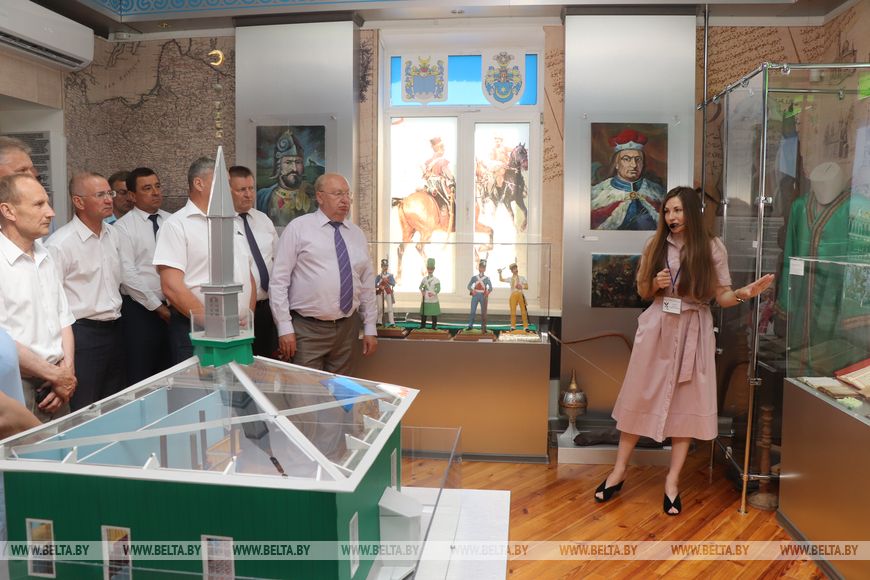
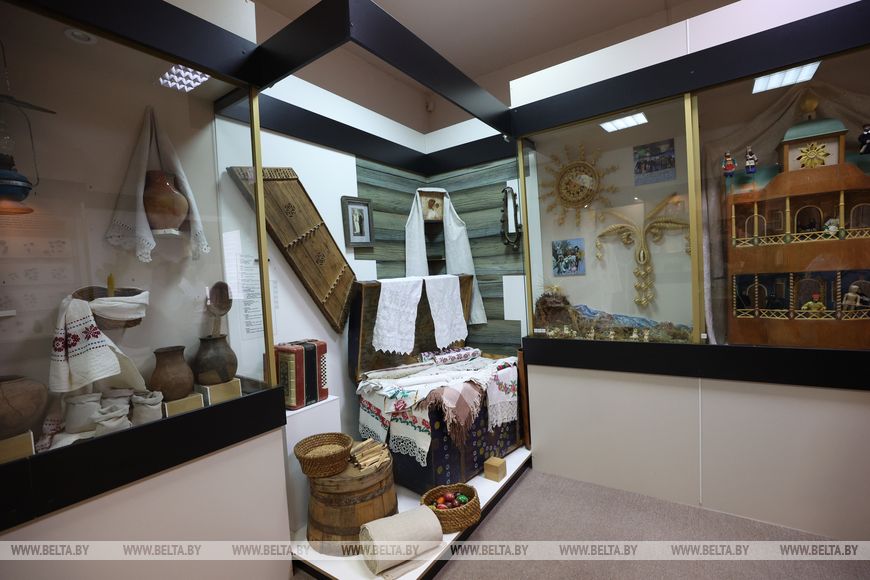
We learned more about the mughirs at the Ivye Museum of National Cultures. Mughirs are special works of art depicting typical Belarusian plants and flowers, seamlessly complemented by Quranic verses.
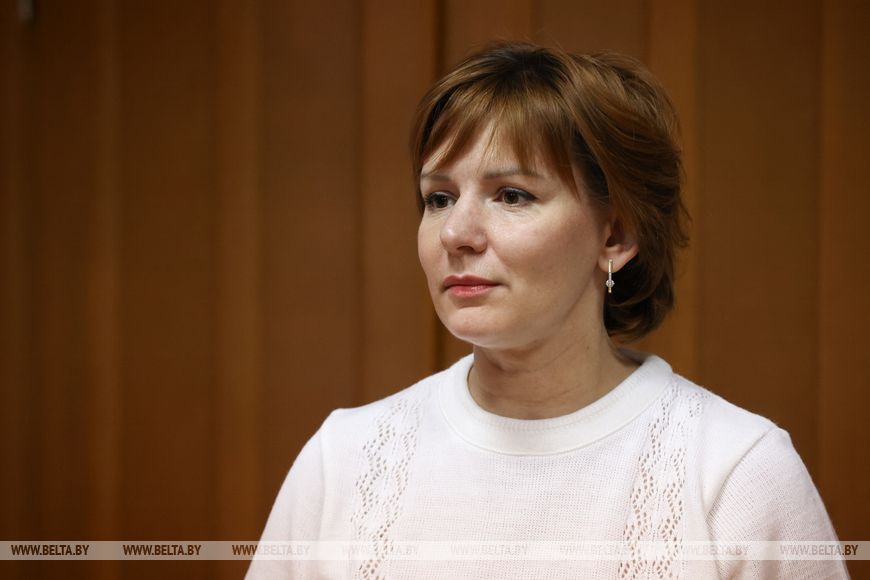
“The mughirs emerged thanks to the local residents’ knowledge of Arabic,” explained Museum Director Alena Viktorova. “Typically, these are almost childish drawings on paper, fabric, glass, and other surfaces, featuring a Quranic quote, a surah.” The most common phrase is “There is no god but Allah, and Muhammad is his Messenger.”
At the museum, we met one of the mughir creators, Selim Ilyasevich, who participated in the restoration of the Ivye Mosque. He is a museum research fellow and a teacher at the Children’s Art School. He not only creates mughirs himself but also shares his expertise with children.
The museum has recently acquired a unique exhibit: a mughir created on a homespun towel.
“Notice that the towel is simple, not festive, embroidered with large flowers, like the kind our grandmothers used to embroider on bedspreads and pillowcases, and next to it is the Arabic text of a surah from the Quran,” noted the director.
Furthermore, in 2024, the intangible cultural practice known as “The Creation of Mughirs” was officially designated a historical and cultural treasure of Ivye District, Grodno Oblast.
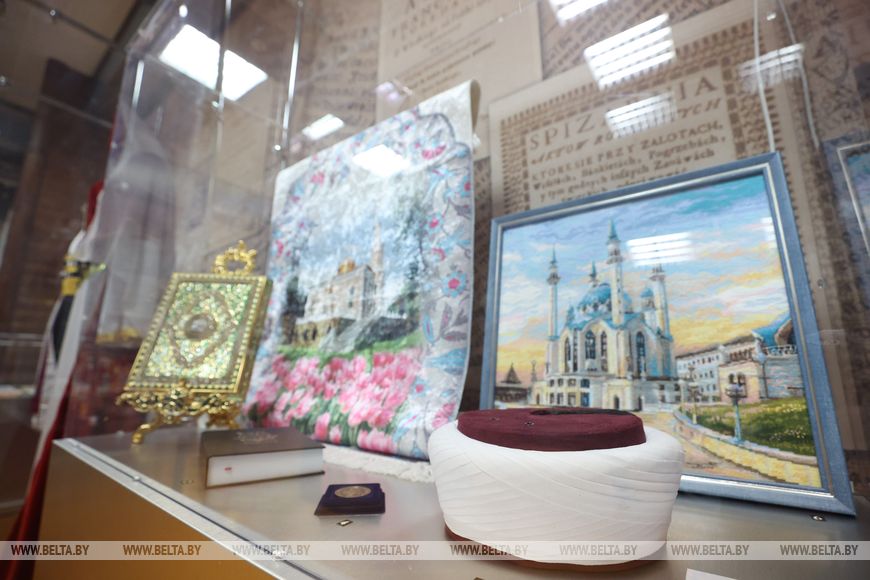
This list also features the “Three Kings” Christmas ritual, local straw-based items, and potato dishes such as draniki and tataravanka.
The Ivye Tatar community is the second largest in Belarus after the Minsk one.
“Representatives of different faiths and cultures have lived in peace and understanding in our town for centuries,” noted Museum Director Alena Viktorova. “However, the dynamics and structure are constantly changing. While before the Great Patriotic War 70% of the Ivye population was Jewish, today 70% are Catholics, and another 15% each are Orthodox and Muslim. But it is the Tatars, who practice Islam, and the Ivye Mosque, recognized as the spiritual center of Islam in our country, that make Ivye unique.”
And so the ongoing story of Islam in Belarus continues with the muezzin’s call on Fridays and holidays, the daily prayers facing Mecca, the children learning the sacred text.
Tamara MARKINA,
Photos by Andrei SINYAVSKY and BelTA,
7 Dnei newspaper.
Follow us on: