

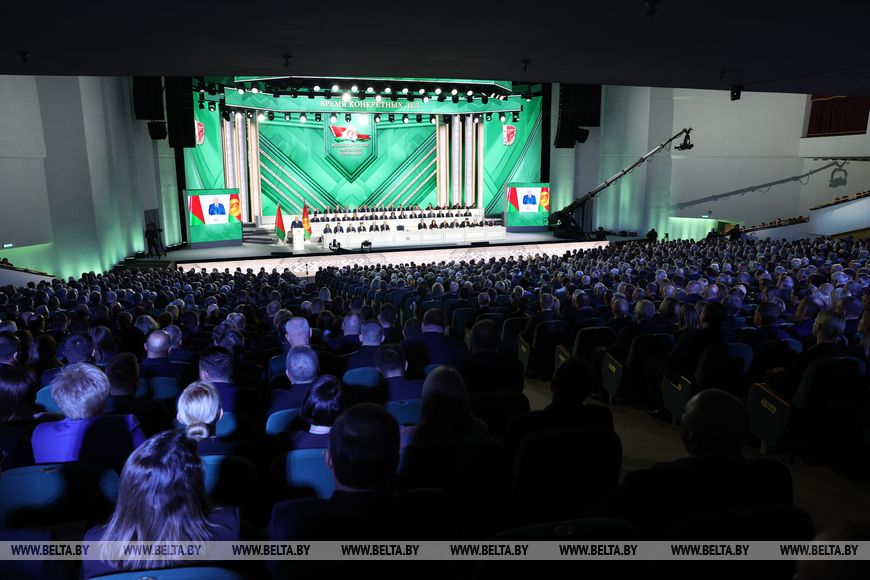
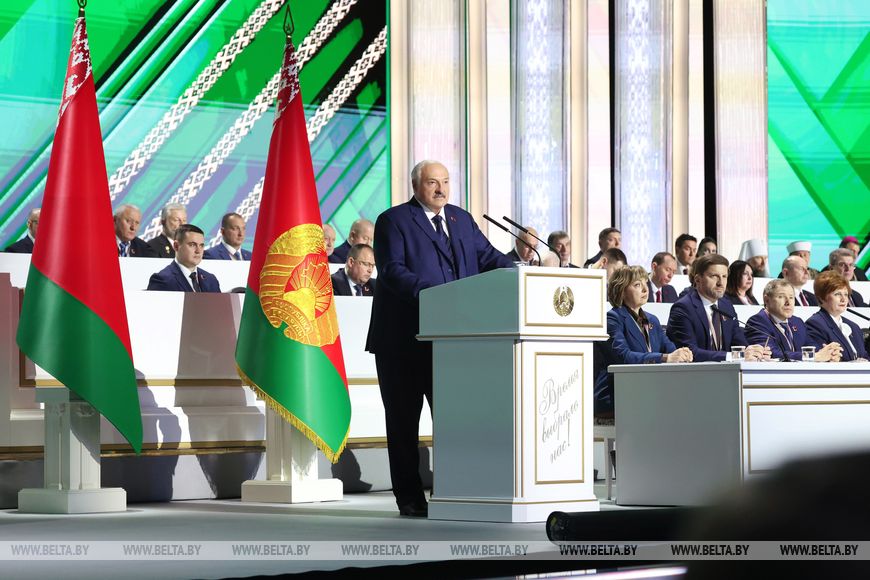
MINSK, 18 December (BelTA) – Saving the Belarusian village as one of the most important tasks for me, Belarusian President Aleksandr Lukashenko said in his Address to the Belarusian People and Parliament during the second session of the 7th Belarusian People’s Congress on 18 December, BelTA has learned.
The president did not rule out that, to address the problem of people leaving the regions, a limit may be set on the construction of new housing in Minsk: no more than 300,000 square meters per year, or possibly less.
“The alternative is satellite cities. Let’s create a similarly high-quality, fully-fledged urban environment there and in the adjacent territories. Although I see there is a sea of problems here. We will also comprehensively examine this topic next year,” the head of state said.
In this context, the president mentioned the idea of developing satellite villages instead of satellite cities: large settlements to ensure a more even distribution of the population. This would involve around 200 villages.
He also recalled the words of Vasily Shukshin from an interview after the release of the film Kalina Krasnaya, which was watched by 140 million people: “With the destruction of the village we will lose morality and spirituality, we will be deprived of our identity. These are our roots, a special way of life, the labor that shapes us. Without our land, a person, like a blade of grass, is at the mercy of every wind.” The president said he was ready to sign his name under those words.
That is why, for the sake of preserving the village, Aleksandr Lukashenko pays great attention to agriculture and regularly visits the regions and enterprises of the agro-industrial complex.
“My task is to save the village! So that it is not empty with collapsing houses, but a place where people live. That is the essence,” the Belarusian leader emphasized. “The village is the foundation of our life. Without it, we will perish. The state cannot exist without the village.” These words were met with applause from those present.
As an example, the president cited the situation in African countries, where the most pressing issue was to provide people with food. Belarus was able to help, for instance, Zimbabwe, fully ensuring the country’s food security. After that, other states on the continent expressed interest in cooperation with Belarus. “We go there as friends. As brothers, as they call us. We train, transfer technologies, build enterprises that are needed,” Aleksandr Lukashenko noted. “We do everything for them. But not for free. This is proof that the state will spend its last resources to solve the task of feeding its own people.”
To maintain the level already achieved in the economy, including in agriculture, Belarus must work hard, adding at least 2-2.5% to GDP, the president believes.
“On the other hand, when speaking about villages, I am not blind to reality and I clearly see that the very small villages, once called ‘unpromising’, certainly have no prospects for development,” the head of state remarked. According to him, this is an objective process, a global trend. Many farms in the country’s agro-industrial complex have gradually been consolidated, and today there are already agricultural giants, such as Dzerzhinsky AgroKombinat, which uses more than 100,000 hectares of land, comparable to the area of entire districts. In addition, a number of agricultural processes have been robotized, requiring fewer people.
Currently fewer than 2 million Belarusians live in rural areas, which is 10% less than at the time of the Soviet Union’s collapse.
“We need to retain people in agro-towns and large villages. Provide them with a normal life [infrastructure for living],” the head of state noted. “All this in most cases requires significant financial and time costs. Therefore, all program documents, both national and regional, must be coordinated. Otherwise we will face a huge imbalance in development.”