Society
01 мая 2026, 23:51
You use it every day! Why Zhores Alferov won the Nobel Prize in simple terms
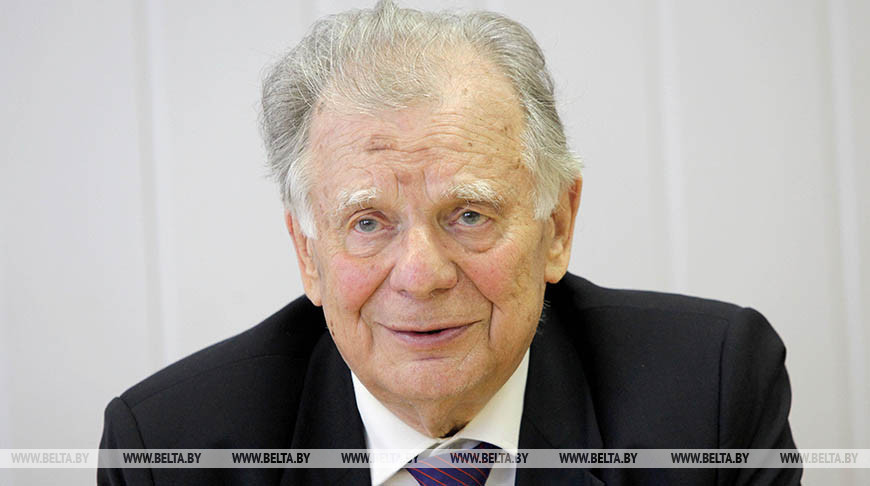
Zhores Alferov. An archive photo
MINSK, 1 May (BelTA) – The physicist and Nobel Prize laureate Zhores Alferov laid the foundations of nanophotonics and all modern technologies. Without him there would be no fiber-optic communication. Academician of the National Academy of Sciences of Belarus, Director of the Institute of Physics, Doctor of Physical and Mathematical Sciences, Professor Sergei Gaponenko and Konstantin Kovalevich, a physics and computer science teacher at Secondary School No.3 in Bereza, talked about it in a recent episode of BelTA’s project On Point. Our People.
Fiber-optic communication, the use of lasers, and solar energy are the fields that utilize discoveries made by Zhores Alferov. “He laid the cornerstone in the foundation of the field of modern science and technology that we today call nanophotonics. There is simple ‘photonics’, which means everything related to light. This includes all lighting engineering, all optoelectronics, all photovoltaics, all lasers, all optical communication. And then there is nanophotonics where nanostructures, very small ones, are used for photonics,” Sergei Gaponenko emphasized, giving a simple example: a nanometer is the size of the water molecule.
What did the outstanding Belarusian scientist propose, and how have his studies made modern life easier? “Zhores Ivanovich [Alferov] surmised that it is possible to make crystalline structures where a very thin layer of one crystal is grown on the surface of another crystal,” the Institute of Physics director said. “The layer is so thin that the electrons in this layer feel a bit cramped. They feel as if they are confined in a very tight space, and then another such layer is grown on top. For this to happen the atoms have to align with each other, recognize each other, and the crystal lattice has to be uniform, but the atoms have to alternate: a layer of one type of atom, then a layer of another type. He suggested that it could be done. This is the essence of the patent he filed in 1963 together with Rudolf Fyodorovich Kazarinov. The patent has two authors. It took several years before it could be implemented, and then, about 10 years later, a real boom began. Today no optoelectronic device exists without these structures. They are called double heterostructures. Eventually, by 2000 humanity realized what it owed to Zhores Ivanovich Alferov, and he became a Nobel laureate.”
The scientist emphasized that all the Internet at home comes through the fiber-optic cable which have been created by leveraging Alferov’s discovery. “When fiber optics is brought into an apartment, that already means you use the structures that Alferov and his team predicted and were the first to create. We still remember optical discs. An optical disc is recorded and read using a laser, which is also a nanoheterostructure. Modern solar cells are all made only using heterostructures,” Sergei Gaponenko said, stressing that this discovery was crucial for the space industry.
The scientist also said that heterostructures are used in every LED light bulb.