Partners
14 студзеня 2025, 09:12
World's smallest sauropod footprints found in Xizang
BEIJING, 14 January (BelTA - China Daily) - Scientists
have discovered the world's smallest known footprints of the sauropod
dinosaur species in the eastern Xizang autonomous region, dating back
approximately 170 million years to the Jurassic period, researchers
announced.
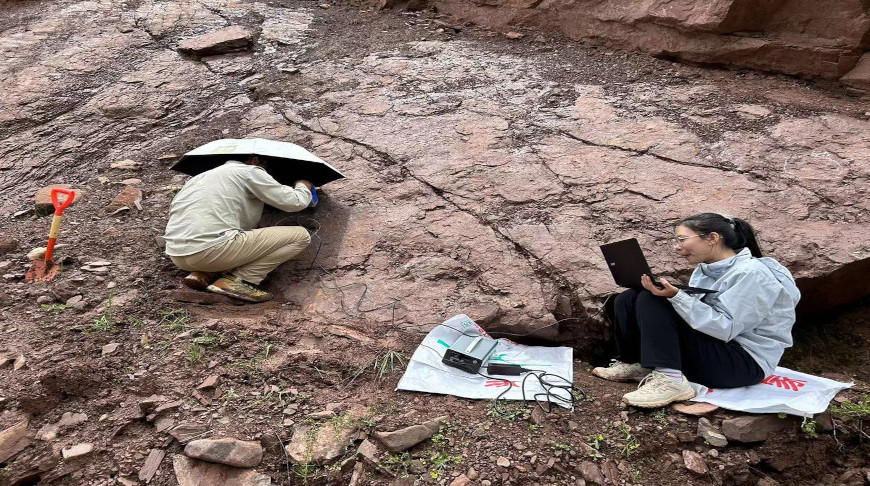
The footprints, found in a village in Chamdo
city, range from 8.8 to 15.5 centimeters in length and are believed to
have been left by at least six dinosaurs, identified as belonging to the
Parabrontopodus track group, said Xing Lida, an associate professor at
the China University of Geosciences in Beijing.
"These tiny
sauropod footprints are quite rare," Xing said. "South Korea has a
record of 12.2 centimeters, and Inner Mongolia in China has recorded
footprints ranging from 11.5 to 13 centimeters. However, both were from
the Cretaceous period, tens of millions of years after the Jurassic
period."
The findings, published in the journal Historical
Biology in late December, suggest the existence of small sauropod
dinosaurs in the region. The team estimates the body length of the
dinosaurs that left the tracks to be between 2 and 3 meters.
Xing
explained that sauropod dinosaurs, which could grow to lengths of 20 to
30 meters, started life as hatchlings less than half a meter long. This
significant size difference led to variations in behavior and diet
between juveniles and adults, often resulting in age-based segregation
within sauropod groups.
In addition to the small footprints,
researchers also discovered three large theropod dinosaur footprints
measuring about 42 centimeters each. These prints, classified as the
ichnogenus Eubrontes, suggest the presence of medium-sized carnivorous
dinosaurs, potentially reaching lengths of 6 meters, he said.
The discoveries add to the understanding of the region's ancient environment.
The
Qinghai-Tibet Plateau, the world's highest and youngest plateau,
reflects the complex evolutionary history of the Tethys Ocean, an
ancient body of water. During the Early Jurassic period, the area was
transitioning from marine sedimentation to inland basins, said Chen
Xinyu, a senior engineer with the China Geological Survey.
Xing
said, "This new fossil evidence strengthens the hypothesis that eastern
parts of southwestern China were once part of the ancient Tethys Ocean."
He
added that the region holds significant potential for further dinosaur
research, with implications for both science and education.
"These
discoveries indicate there is still much to learn about dinosaurs in
Xizang, and the findings underscore the importance of continued
exploration," he said.