Partners
26 лістапада 2025, 10:06
TV BRICS supports expert session on Russian low-carbon development projects
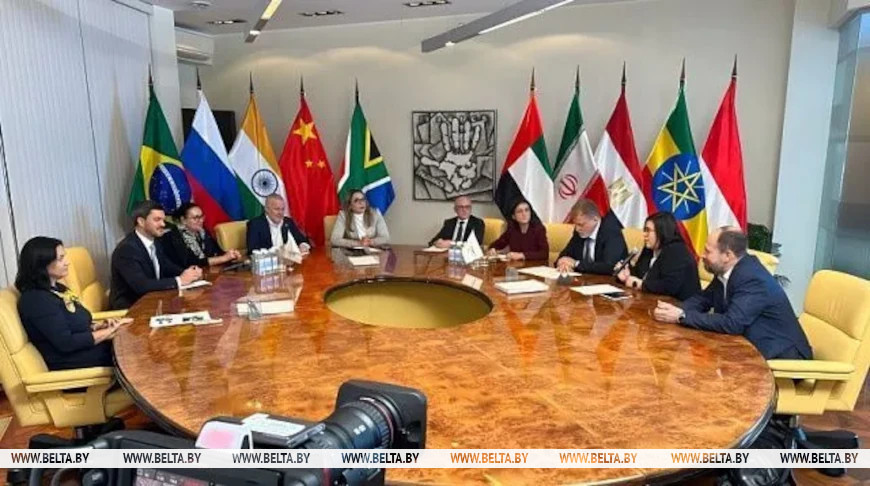
Photo: TV BRICS
MOSCOW, 26 November (BelTA - TV BRICS) - An expert session titled
“The potential for replicating successful practices and mechanisms of
Russia’s first climate experiment to achieve national development goals”
was held at the office of the TV BRICS International Media Network. The
event is timed to coincide with the UN Climate Change Conference
programme in Belem, Brazil.
The discussion was organised by the
UN Global Compact Network Russia, the Government of the Sakhalin Region,
and TV BRICS. Representatives of public authorities, leading Russian
companies and the expert community took part in the session.
The
focus of the session was the results of the climate experiment in
Sakhalin. The Minister of Ecology and Sustainable Development of the
region, Andrey Samatov, told TV BRICS in an exclusive comment that the
region had achieved carbon neutrality a year ahead of schedule - as
early as 2024.
“Sakhalin Region achieved carbon neutrality based
on the results of 2024, which is confirmed by the regional inventory of
greenhouse gas emissions and removals. [...] This result was achieved
through the management of the carbon balance, which consists of
emissions from anthropogenic sources of greenhouse gases and absorption
by ecosystems. In terms of emissions, this is primarily due to measures
for the gasification of the region; that is, when the experiment began,
it was around 14 per cent, and now we have already reached about 64 per
cent gasification of the region. [...] The second area is the system for
developing energy efficiency. And, in fact, the system of the carbon
unit market, where both the units for fulfilling quotas [...] and the
carbon unit market in the voluntary implementation of climate projects
could be used to achieve the overall goal,” he added.
The
exchange of best practices between companies and countries became
another important focus of the session. Vladimir Lukin, an expert in
climate change, energy efficiency and sustainable water resources
management, emphasised in a comment for TV BRICS that the very attitude
towards sustainable development is changing in Russia. Whereas
previously the approach was largely reactive - when decisions followed
an already established international agenda - today the shift towards
perceiving sustainable development as an independent tool for internal
growth and the country’s long-term development is becoming increasingly
evident.
Sergey Machekhin, Deputy Director General for Project
Engineering, Sustainable Development and International Cooperation at
RusHydro, spoke about the contribution of hydropower to the climate
agenda and cooperation with BRICS countries.
“Climate change has
no geographical boundaries [...] Therefore, globalisation in this
segment [...] is, of course, first and foremost unifying technologies.
If we talk about the planet as a whole, renewable energy sources (RES),
hydropower and climate change are extremely interconnected areas of
activity. [...] In BRICS countries, we offer the replication of the best
available technological solutions absolutely free of charge. We will be
happy to teach and help use such solutions,” he added exclusively for
TV BRICS.
The session was part of the systemic work of TV BRICS
to promote the UN Sustainable Development Goals (SDGs) and to cover the
global climate agenda. In 2025, the media network provided information
support for the COP30 summit across its platforms.
The
cooperation between TV BRICS and the UN Global Compact Network Russia,
formalised by an official agreement, is aimed at providing information
support for Russian business in the field of CSR and sustainable
development, as well as promoting successful national practices through
the media platforms of BRICS+ countries.
As part of its own
programme of events on the sidelines of COP30, the UN Global Compact
Network Russia also organised other sessions dedicated to the role of
youth, the harmonisation of carbon markets, the energy transition, and
the sustainable development of indigenous peoples.