Partners
19 ліпеня 2024, 10:23
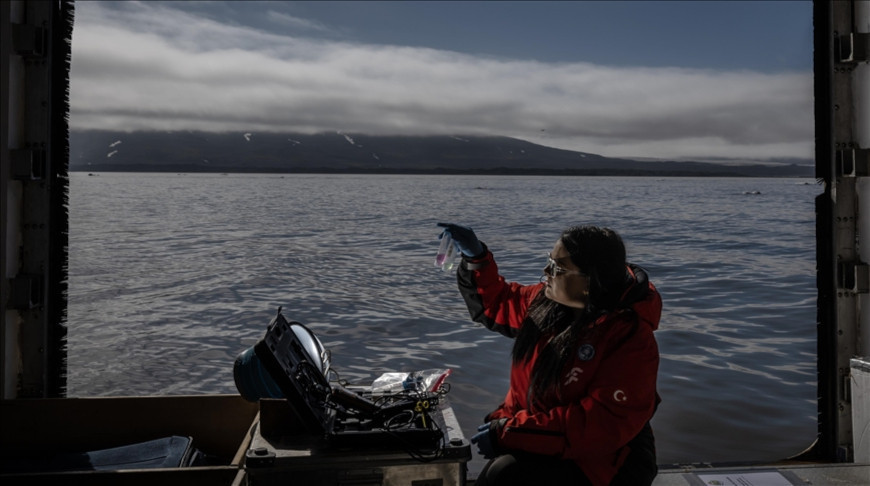
Turkish arctic expedition seeks crucial insights into climate change
ISTANBUL, 19 July (BelTA - Anadolu) - Türkiye's fourth National Arctic
Scientific Research Expedition, comprising an 11-member team, is
currently conducting 16 diverse projects in the Arctic Ocean to shed
light on the future of our planet.
Under the auspices of the
Turkish Presidency and Ministry of Industry and Technology, and
coordinated by TUBITAK MAM Polar Research Institute, the expedition
includes researchers from various Turkish institutions alongside
international collaborators from Bulgaria and Chile.
Professor
Ersan Basar, leader of the expedition, focuses on understanding changes
in the health and dynamics of the Barents Sea ecosystem through the
project titled "Examination of Plankton and Pigment Composition in the
Barents Sea during the 2024 Arctic Summer."
Deputy leader Dogac
Baybars Isiler oversees logistical operations aimed at enhancing
navigation and safety in polar regions, with a focus on maritime
operations and emergency response improvements.
Senior
photojournalist Sebnem Coskun is participating in the expedition to
document the scientific endeavors and the impacts of global climate
change on life. Her work aims to disseminate the outcomes of Türkiye’s
scientific missions in polar regions to a global audience.
Ongoing Research Projects
Cetin
Bicer, electronics engineer from the General Directorate of
Meteorology, is gathering high-precision meteorological data in the
Arctic. This includes air temperature, humidity, wind direction and
speed, atmospheric pressure, sea water temperature, and global solar
radiation, using certified sensors in accordance with WMO standards.
Lieutenant
Engineer Kunter Incili from the Navigation, Hydrography, and
Oceanography Department is investigating the dynamics of Arctic layers
and variations in thermoclines and haloclines around Norway's Arctic
archipelago of Svalbard. His research also examines the impact of
glacier melts on the Barents Sea and surrounding current systems.
Aslihan
Nasif Dondurur from Dokuz Eylul University is studying shallow sea
oceanography in the Svalbard region, focusing on the presence of
freshwater inputs from glacier melts and their relationship with ocean
currents.
Nursu Aylin Kasa from Istanbul Medipol University is
working on detecting pharmaceutical active substances and their
metabolites in environmental samples in the Arctic using advanced
LC-MS/MS techniques. Her research aims to determine trace levels of
these substances in the Barents Sea.
Bilge Durgut from Middle
East Technical University is identifying spatial changes in Arctic
biodiversity using eDNA metabarcoding, evaluating these changes
alongside physicochemical parameters to understand biodiversity
variations across different regions of the Barents Sea.
Gulden
Acil from Istanbul Technical University is researching the detection of
antifouling compounds in aquatic environments, exploring their impact on
marine ecosystem health and biodiversity in the Barents Sea.
Maria
Jose Narino Vargas from the Chilean Antarctic Institute is
investigating phytoplankton dynamics in a changing ocean environment,
examining whether new species emerging in the Arctic Ocean are
potentially toxic.
Petar Sapundjiev from the Bulgarian Antarctic
Institute is developing technical solutions for observing cosmic
radiation variability in polar regions, aiming to enhance the
reliability and functionality of scientific equipment deployed in these
harsh environments.
The expedition team is expected to return to
Türkiye next week, bringing valuable insights and data from their Arctic
exploration.