Partners
24 кастрычніка 2025, 11:04
Impact crater in south China confirmed as world's largest for over 10,000-year period
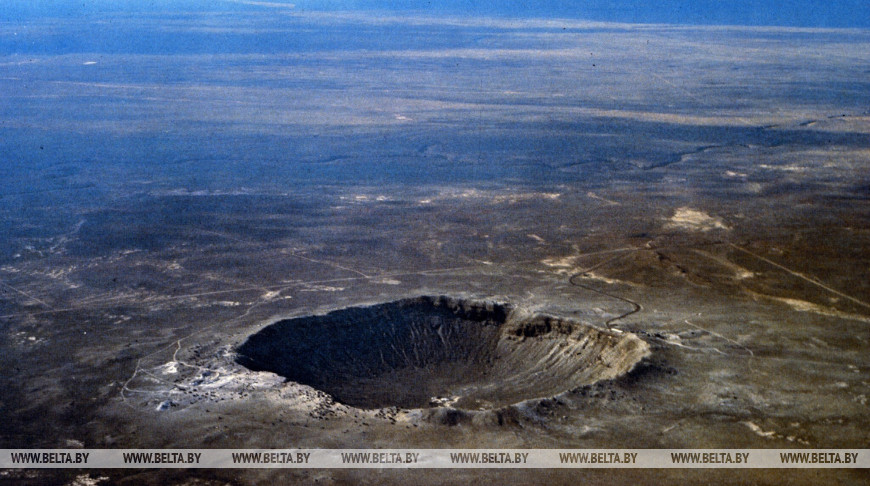
Photo: Space.com / iStock
GUANGZHOU, 24 October (BelTA - Xinhua) - The Jinlin impact crater in
south China's Guangdong Province has been confirmed as the largest known
crater on Earth since the Holocene period, which spans from 11,700
years ago to the present, the China Academy of Engineering Physics
(CAEP) said.
The Jinlin impact crater is located in a
low mountainous area of Deqing County in northwest Guangdong Province.
Researchers estimated that the impact event occurred in the
early-to-middle Holocene based on an analysis of the chemical weathering
rate of local granite, and that the crater is a relatively young impact
structure.
Their findings were recently published in the Matter
and Radiation at Extremes journal. Chen Ming, the first author of the
paper and a researcher at CAEP's Center for High Pressure Science and
Technology Advanced Research, said that through field investigation and
geological sample testing, they found evidence of shock metamorphism in
rocks and minerals caused by strong shock waves in the crater.
They
used this evidence to determine that the crater resulted from the
hypervelocity impact of a small extraterrestrial body, rather than from
Earth's own geological processes.
Chen said that previously
discovered Holocene impact craters around the world are generally small
in scale -- most measuring less than 100 meters in diameter, with the
largest being about 300 meters. The Jinlin crater has a diameter of 900
meters, leading researchers to estimate that the impact had been huge,
with an energy equivalent to 600,000 tonnes of TNT.
In the past,
only four impact craters have been found in China's northeastern
regions. In south China, no traces had been found for a long time due to
destruction caused by the intense chemical and biological weathering of
the region's surface rock layers.
These findings provide
valuable insights for the study of impact craters worldwide, especially
in warm and humid tropical and subtropical areas. They also expand the
spatial distribution data of small body impact events globally.