Partners
06 лістапада 2024, 09:03
Global companies debut cutting-edge technologies amid innovation drive
SHANGHAI, 6 November (BelTA - Xinhua) - With the seventh China
International Import Expo (CIIE) in full swing in Shanghai, global
companies are unveiling their latest technological innovations,
capitalizing on the opportunities arising from China's commitment to
further opening up both its market and manufacturing industry.
GE
Healthcare, a regular exhibitor at the CIIE, has brought an
unprecedented lineup to Shanghai this year. The U.S. medical technology
company is showcasing multiple products either making their global or
Chinese debut.
Eyeing China's growing demand for advanced medical
technology, GE Healthcare is exhibiting its largest collection of new
products ever at this year's expo, where it has been participating since
2018, said Zhong Luyin, the company's China communications executive.
"Our goal extends beyond mere participation in the expo. More importantly, we look forward to engaging in China," Zhong said.
A STAGE FOR ALL
At
the ongoing CIIE, over 400 new products, technologies and services from
around the world are being showcased, spanning sectors such as
artificial intelligence, new materials, autonomous systems and energy
transition technologies.
During a meeting on Monday with select
exhibitors and buyers attending the expo, Chinese Premier Li Qiang said
that China is able to sustain steady economic recovery, improve the
quality and capacity of its market, and provide more extensive growth
space for global businesses in terms of trade, investment and
innovation. He added that the Chinese market is still one of the best
choices for companies worldwide.
Just days ago, China removed all
market access restrictions for foreign investors in the manufacturing
sector, with the country's new edition of its national negative list for
foreign investment having taken effect on Nov. 1. This significant move
marked the latest effort of the world's second-largest economy to open
its doors even wider.
"Benefiting from the 'spillover effect' of
the expo, many of our showcased products are now in use across Chinese
hospitals," said Lu Yi, MRI marketing manager of Siemens Healthineers.
At this year's CIIE, the German medical technology company is unveiling
the MAGNETOM Terra.X, its latest generation of magnetic resonance
imaging (MRI) equipment -- the first time this new equipment is being
displayed in Asia.
Lu revealed that Siemens Healthineers is
advancing its localization strategy for cutting-edge product
manufacturing. Notably, the MAGNETOM Terra.X is slated for future
production at the company's base in Shenzhen, south China's Guangdong
Province.
Apart from traditional technological sectors, the
ongoing expo showcases an array of futuristic exhibits that seem
straight out of the world of science fiction, including tires designed
for lunar exploration vehicles, electric vertical takeoff and landing
(eVTOL) aircraft, and innovative motor-powered shoes.
French tire
maker Michelin, which is attending the expo for a fourth year, is
exhibiting a futuristic prototype wheel for lunar exploration vehicles,
among other products including car tires containing 71 percent
sustainable materials and a new generation aircraft tire.
Serge
Godefroid, research and development director of Michelin China, said
Michelin has been innovating for the future of mobility and is even
thinking about mobility beyond the Earth for future lunar or Mars
exploration projects.
Michelin is already extensively testing
tires in very rough conditions and with exposure to the range of
temperatures that exist on the moon, Godefroid said. "You don't have
somebody to help you inflate a tire on the moon, so you need to find a
wheel that can sustain very difficult conditions."
RISING INNOVATION LANDSCAPE
A
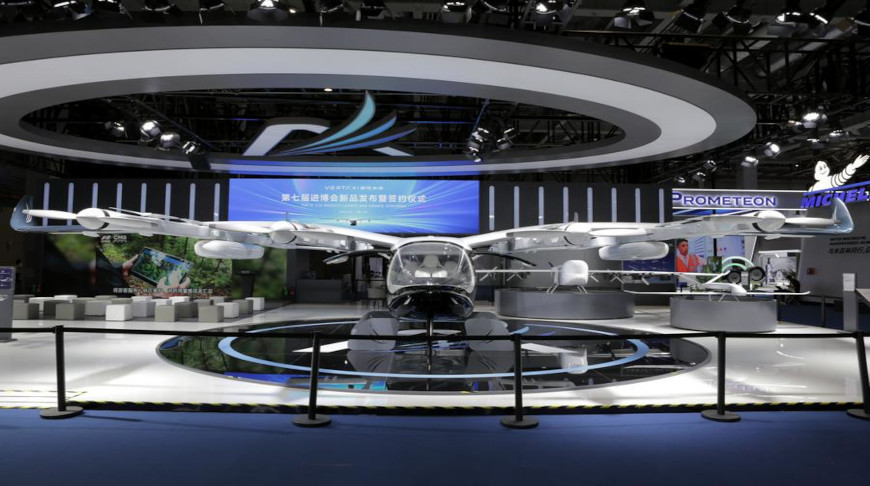
number of eVTOL aircraft are proving eye-catching at this year's CIIE.
Vertaxi, an eVTOL startup which is attending the expo jointly with
Ampaire, a global leader in hybrid electric aircraft systems, has
brought three autonomous eVTOL drones to the 2024 expo.
Yue
Tingting, vice president of Vertaxi, said the company's smaller eVTOL
aircraft have been well received by the market and are being widely used
for police, emergency and fire-fighting patrols, public and oil
infrastructure inspections, and island logistics.
Yue admitted
that it will take longer for the company's eVTOL aircraft to obtain the
airworthiness certification needed for passenger transport. She,
however, is very bullish about China's low-altitude economy and even
envisions a future where people will be able to board eVTOL aircraft for
daily commuting, much like taking a taxi or bus.
Shift Robotics,
attending the expo for the first time, is exhibiting its new generation
of motor-powered shoes, called Moonwalkers Aero, that allow people to
walk at speeds of up to 11 km per hour.
Moonwalkers deliver
smooth power when people who wear them speed up, while they offer very
little assistance if the person wearing them walks very slowly. These
motor-powered shoes can be used in virtually any environment, even on
the subway, in a lift or on stairs, and people can move around in these
Moonwalkers without taking off their normal shoes, according to Zhang
Xunjie, CEO of Shift Robotics.
From industry giants to rising
startups, the dedication shown to China by global tech companies is
well-timed, as the country's prominence in the global innovation
landscape continues to increase. According to the Global Innovation
Index 2024 released by the World Intellectual Property Organization,
China has moved up one spot to 11th place in the latest rankings of the
world's most innovative economies -- becoming one of the fastest risers
over the past decade.
"China's growth pattern has shifted from
quantity-oriented to quality-oriented," said Tetsuro Homma, executive
vice president of Panasonic Holdings Corporation. "To keep pace with
this change, we are setting up more research and development teams in
China to quickly adapt to the evolving Chinese market."
Over the
past four years, this Japanese manufacturing company has steadily
expanded its investment in China. Home to over 60 Panasonic
subsidiaries, China now accounts for nearly a quarter of the company's
business worldwide. "We are innovating for China, and we aspire to
innovate in China for the whole world," Homma said.