Partners
05 мая 2026, 12:53
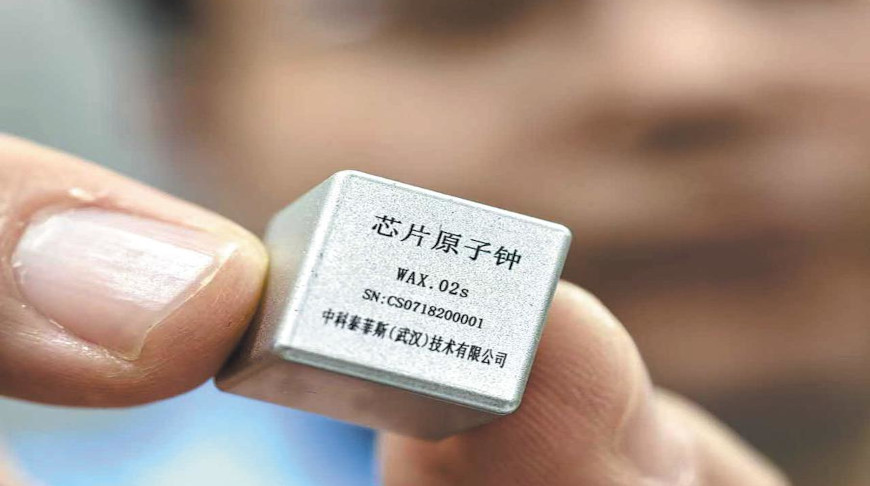
Fingernail-sized atomic clock enables ultra-precise timing systems
BEIJING, 5 May (BelTA - China Daily) - China has taken a significant
step in high-precision timekeeping by mass-producing a fingernail-sized
chip-scale atomic clock that is accurate to within one second over
30,000 years. The advance provides a high-precision timing foundation
for strategic applications such as low-Earth-orbit satellites and
underwater Beidou navigation systems.
The device, developed by
Wuhan University's Satellite Navigation and Positioning Technology
Research Center in Hubei province, measures just 2.3 cubic centimeters -
about one-seventh the size of comparable products made in the United
States - while delivering similar performance.
"Time is a
strategic resource, and those who achieve the highest precision in
timekeeping gain an advantage in technology, economy and even national
defense," said Chen Jiehua, a professor at the center and legal
representative of Zhongke Taifeisi (Wuhan) Technology Co, in an
interview with Changjiang Daily.
Chen explained that precise
timing is essential for navigation and positioning. "Time is distance in
navigation and positioning - a time error of just one nanosecond, or
one billionth of a second, leads to a positioning deviation of 0.3
meters. However, even the most accurate daily timepieces can drift by
more than 10 seconds per year," he said. This challenge has driven his
team to spend decades developing chip-scale atomic clocks to secure
reliable, independent timing technology.
Unlike conventional
clocks, atomic clocks keep time by measuring the natural vibrations of
atoms, which occur at extremely stable frequencies. Traditional atomic
clocks use microwave signals to interact with atoms, but the relatively
long wavelength of microwaves limits how small the devices can be made.
Chip-scale
atomic clocks take a different approach. They use lasers controlled by
microwave signals, allowing the system to be built in a much smaller
space. This design maintains high precision while significantly reducing
size and power consumption.
Chen said the clocks have broad
market potential. Their compact size - just a few cubic centimeters —
and low power consumption of less than 200 milliwatts make them suitable
for use in challenging environments such as underwater systems. In such
settings, satellite signals are unavailable and solar energy cannot be
relied on, so devices need their own stable, low-power time reference to
stay synchronized over long periods.
Zhongke Taifeisi (Wuhan)
Technology Co has achieved large-scale production of the clocks, which
have already been used in time synchronization systems for underwater
Beidou, low-Earth-orbit satellites and drone swarms.
Gou Fei, an
official with the Yangtze River Industry Group, which holds more than 20
percent of the company's shares, said quantum technology has been
identified as a priority among China's future industries. The field
includes quantum precision measurement, where chip-scale atomic clocks
are a core component.
"The world's smallest chip-scale atomic
clock, developed by professor Chen Jiehua's team, has broken the foreign
technology monopoly," Gou told Changjiang Daily. "It achieves a
comprehensive leap forward with smaller size, better performance and
scalable production."
The product is the first - and currently
the only - chip-scale atomic clock in China to achieve commercial sales
at scale. It sold several hundred units in 2024, with sales continuing
to grow in 2025, Gou said.
However, large-scale production still
faces challenges, particularly the high cost and performance limitations
of key components such as lasers. Gou said the group plans to use its
resources to help the company improve these technologies and expand
automated production, reducing costs and broadening applications in both
military and civilian communications.
China's 15th Five-Year
Plan (2026-30) highlights the need for breakthroughs in quantum
precision measurement technologies and promotes quantum technology as a
new driver of economic growth.