Partners
06 красавіка 2026, 09:09
Chinese surgical robots operate in global theater
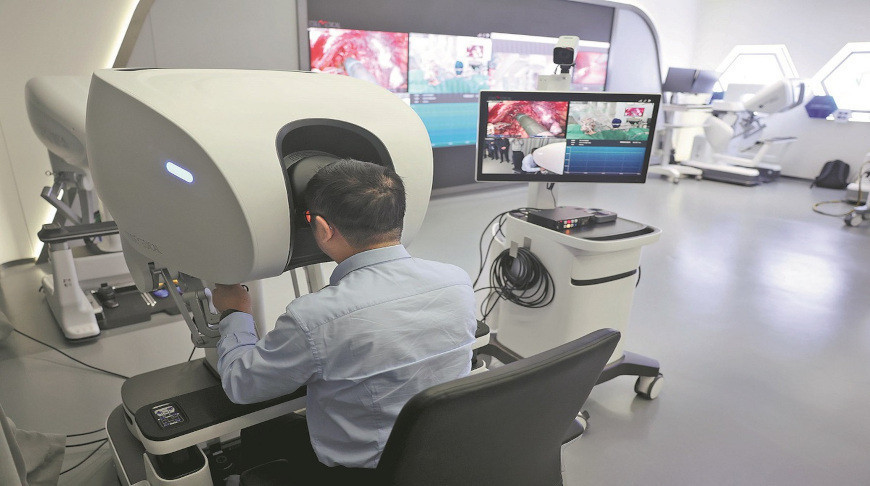
BEIJING, 6 April (BelTA - China Daily) - Seated at a console inside a
hospital in Southwest China's Sichuan province, Piotr Suwalski, a
Polish doctor, fixed his gaze on the screen ahead of him while
manipulating a surgical robot located more than 7,000 kilometers away in
Poland.
About two hours later, the surgery was successfully
completed, boosting the doctor's confidence in promoting the technology
back home.
Suwalski, director of the National Medical Institute
under Poland's Ministry of the Interior and Administration, said the
surgical field was exceptionally clear, while the patient experienced
less bleeding compared with traditional open chest surgery.
The
surgery was one of seven remote operations successfully conducted at the
West China Hospital of Sichuan University's international remote
robotic center in early March in Chengdu, the provincial capital.
Inaugurated
on March 21, the center aims to become an international smart-surgery
platform, promoting a shift in medical services from "bringing patients
in" to "sending technologies out".
Wu Hong, a liver transplant
expert and vice-president of the hospital, said the establishment of the
center means a tangible medical benefit for patients.
He
highlighted hepatobiliary and pancreatic surgery as examples. "Compared
with traveling to Chengdu for the surgery, patients and their families
can now undergo robot-assisted surgery in their hometowns, cutting
financial and time burdens by up to 80 percent."
To ensure safety
during remote surgery, a professional team comprising surgical
specialists, anesthesiologists, nursing personnel, network engineers and
equipment engineers has been set up at the center, operating under a
24/7 emergency response mechanism.
Carlos Eduardo Domene, a
Brazilian doctor, also performed surgery from the center on a patient
over 10,000 km away in Brazil via the remote robotic surgery system.
Also
the president of the Brazilian Robotics Association, Domene marveled at
the device's ultra-high-definition, zero-latency performance. "China's
top-tier medical technologies and equipment are now being introduced to
Brazil through the Belt and Road Initiative, benefiting more patients
across South America," Domene added.
The year 2026 marks a
milestone for China's surgical robot industry, as the release of the
country's first guidelines on pricing for such services is expected to
usher in a new phase of regulated growth, driven by both policy support
and rising market demand.
Meanwhile, on a broader global scale,
China's surgical robots have already drawn increasing attention.
According to data from the China Chamber of Commerce for Import and
Export of Medicines and Health Products, the export of China's surgical
robots soared 368 percent year-on-year in 2025, reflecting the rapidly
rising global recognition of China-made medical equipment in terms of
both technological capability and international competitiveness.
As
the Belt and Road Initiative continues to advance, Chinese surgical
robots and other medical devices are speeding up their expansion into
overseas markets.
The country's exports of medical equipment
totaled $45.8 billion in 2025, up 62.4 percent compared with 2019, said
the China Association of Medical Equipment, adding that China's medical
equipment sector has been shifting from a cost-driven competitive edge
to one based on technology and brand strength.
At an
international surgical robots conference held in late March in Chengdu,
more than 700 experts and scholars from countries and regions across
North America, Europe and Asia discussed innovation and development in
surgical robot technologies.
Luo Fengming, president of the West
China Hospital of Sichuan University, said at the conference that the
inauguration of the hospital's international remote robotic center will
continue to promote the innovative development of surgical robot
technologies.
The hospital also plans to establish a surgical
robot remote control center in Egypt in July to support the local
adoption of the technology and help doctors enhance their ability in
this field, ultimately benefiting patients there.
Looking ahead,
Luo believes efforts should focus on improving the remote surgery
network and further exploring technological innovation, clinical
translation, talent training and other aspects. "Through closer
international collaboration, we will work together to advance surgical
robots into a technology that is more precise, intelligent and
accessible," said Luo.