Partners
22 красавіка 2025, 10:06
Chinese scientists develop world's smallest untethered terrestrial-aerial micro-robot
BEIJING, 22 April (BelTA - Xinhua) - Enabling robots to walk, run, jump,
fly, climb and "lock" into arbitrary shapes in real-time is crucial for
expanding their application scenarios.
A research team from
Tsinghua University in Beijing has developed a thin-film-shaped
small-scale actuator which enables micro-robots to continuously
transform their shapes and "lock" into specific configurations, much
like the "Transformers" seen in a famous cinema attraction, and thereby
significantly enhancing their environmental adaptability. This
breakthrough has been published online in Nature Machine Intelligence, a
leading international journal.
"By integrating this actuator
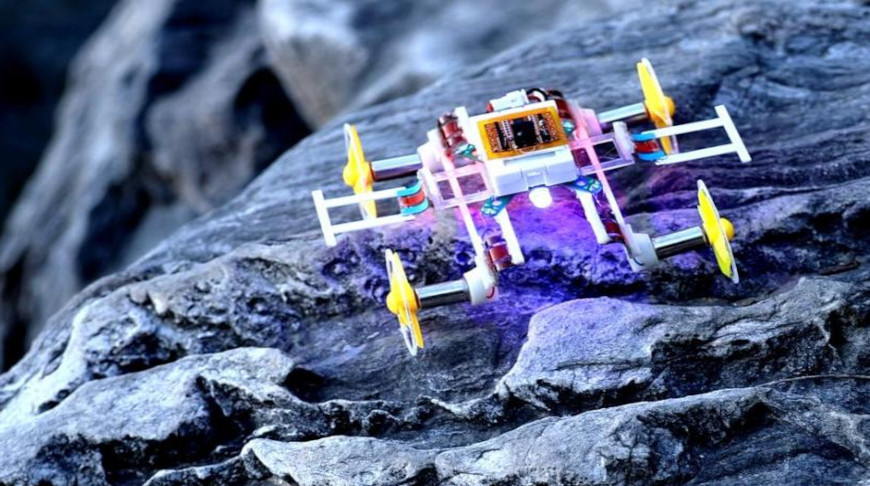
with our Lego-inspired design strategy, we created the world's smallest
and lightest untethered terrestrial-aerial micro-robot known in the
relevant literature, measuring just 9 centimeters in length and weighing
25 grams," said Zhang Yihui from Tsinghua University's School of
Aerospace Engineering and the State Key Laboratory of Flexible
Electronics Technology.
Actuators, the "heart" of micro-robots, are devices with controllable shape-morphing capability.
"Developing
untethered, ultra-compact micro-robots with complex shape-morphing
capabilities is extremely challenging," Zhang explained.
Existing
actuators measuring under five centimeters in size typically face
challenges in achieving continuous shape morphing and locking, severely
limiting miniaturization and untethered control of multimodal robots.
Through
innovative synergistic material-structure design, Zhang's team
developed a miniature actuator as small as a few millimeters in size.
Serving as a "morphable exoskeleton," it can integrate functional
components like sensors and motors to build complex robotic systems.
Notably,
this actuator can be electrically controlled to continuously morph into
any desired shape and then "lock" the deformed configuration, which was
difficult to achieve with previous small-scale actuators.
"Using
the Lego-inspired design strategy, we constructed an untethered
terrestrial-aerial micro-robot capable of agile aerial flight and land
movement, and with a speed of up to 1.6 meters per second on the
ground," Zhang said.
In addition, the team also developed a
4.5-centimeter-high, 0.8-gram mini-"Transformer" actuator employing more
than ten actuator units, as well as a multi-functional wheeled robot
that can morph into "sports car," "winged car," and "van" modes.
Inspired
by grasshoppers and other insects, researchers incorporated biological
morphologies and locomotion capabilities into their designs.
This
work offers new ideas and routes for the development of micro-robots.
"Future applications include equipment diagnostics, geological surveys,
and hazardous environment operations," Zhang said. "The actuator can
also be used in bio-electronic devices, enabling the development of
deployable implantable medical devices and VR/AR haptic interfaces."