Partners
07 мая 2025, 11:24
Chinese music festival celebrates cross-cultural harmony
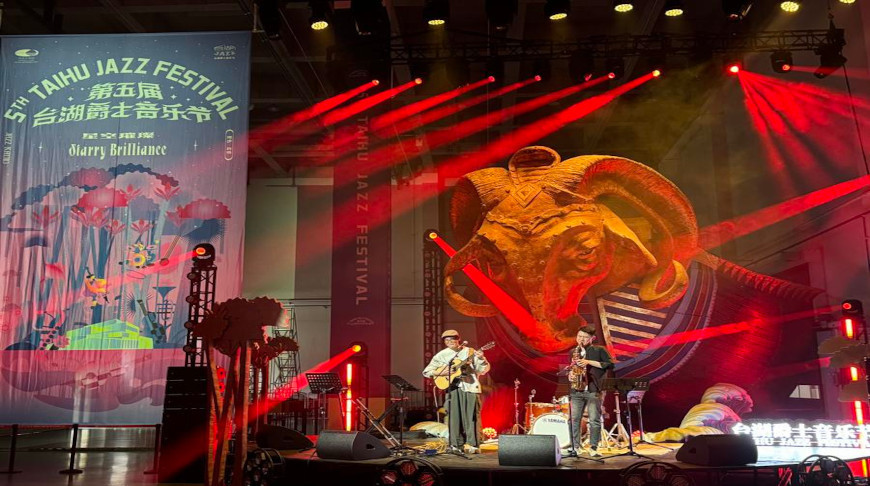
BEIJING, 7 May (BelTA - Xinhua) - At a Chinese international jazz
festival that wrapped up on Monday, musicians from across the world
delivered a dazzling fusion of jazz and cross-cultural collaborations.
The
2025 Taihu Jazz Festival, which was held at the Taihu Stage Art Center,
a branch of China's National Center for the Performing Arts (NCPA) in
Beijing, attracted over 200 musicians from nine countries.
As
Yannick Rieu, a renowned Canadian saxophonist, noted in an interview
with Xinhua, "Jazz is a vibrant musical form that transcends borders and
differences."
During the festival, Rieu presented a jazz quartet
centered around the theme of integration, in which he especially
included an adaptation of the Chinese folk song "Yimeng Mountain." "The
song deeply moved me -- from the first listen, I felt an intimate
emotional connection."
While recomposing the song, the musician
strove to preserve its soul and infuse it with jazz's signature freedom
and improvisation, allowing Eastern and Western voices to naturally
blend together.
"From majestic landscapes to unique folk
traditions and vibrant regional music, China's rich and diverse culture
is an endless source of inspiration for me," said Rieu, who has traveled
and performed in China nearly 20 times since 2006.
Over the
years, he has witnessed China's rapid evolution -- not only in its
infrastructure but also in its thriving arts scene. "New festivals,
music schools and clubs are springing up in China, nurturing a wave of
exceptional young musicians eager to blend jazz with their own cultural
identity," he said.
Li Xiaochuan, a rising star in the Chinese
jazz scene, stands out as a talented trumpet player and composer. This
time at the Taihu festival, he merged not only traditional Chinese
instruments but also artificial intelligence (AI) into his composition
and performance.
"We must dare to experiment, distill our
insights, and share them with students and audiences, sparking fresh
perspectives through transformative musical experiences," said Li, who
is also an associate professor at Shanghai Conservatory of Music,
stressing the importance to embrace AI in music education and
performance.
"Jazz should never become museum music -- it must speak with a contemporary voice," he added.
Li's
opinion is echoed by Argentinian pianist Adrian Hugo Iaies and his trio
members. For them, the term jazz, which originated in the West, is more
of a tool or musical approach rather than a precise style after years
of constant evolving, expanding and changing.
"The music I wrote
for the trio is music that has a very strong connection with Argentinian
traditions. It's music that sounds in our towns and households," he
said.
Meanwhile, at the festival, HAYA, a world-renowned music
band rooted in Chinese ethnic music, such as Mongolian, Kazakh and
Tibetan music, showcased the vitality of traditional sounds by blending
them with modern elements.
"Music is a universal language of all
peoples," said Zhang Quansheng, founder and Morin Khuur player of HAYA,
adding that it is vital to draw upon the strengths of diverse musical
traditions.
In recent years, China has been endeavoring to
promote music exchanges with the rest of the world. "Culture knows no
borders. We'll continue to build a highland of jazz in China to bridge
divides and foster mutual understanding," said Guan Jianbo, vice
president of the NCPA.