Partners
28 жніўня 2025, 12:47
China's ultra-large neutrino detector starts operation to find "ghost particles"
GUANGZHOU, 28 August (BelTA - Xinhua) - The world's largest
transparent spherical detector began operation in China, making it the
world's first operational ultra-large scientific facility dedicated to
neutrino research with ultra-high precision.
Having completed the
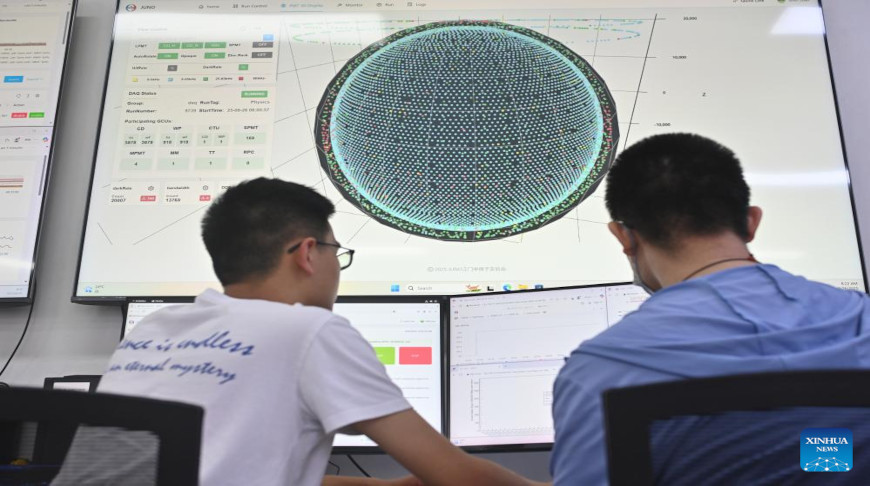
filling of its 20,000-tonne liquid scintillator detector, the Jiangmen
Underground Neutrino Observatory (JUNO) in south China's Guangdong
Province began taking data after more than a decade of preparation and
construction.
The initial data taken during a trial operation
showed that key performance indicators met or exceeded design
expectations. This success positions JUNO to address one of the major
questions in particle physics this decade: the ordering of neutrino
masses.
"Completing the filling of the JUNO detector and starting
data taking mark a historic milestone. For the first time, we have put
into operation a detector of this scale and precision dedicated to
neutrinos. JUNO will allow us to answer fundamental questions about the
nature of matter and the universe," said Wang Yifang, JUNO's
spokesperson and a researcher at the Institute of High Energy Physics
(IHEP) of the Chinese Academy of Sciences (CAS).
Since neutrinos
rarely interact with ordinary matter, they can easily zip through our
bodies, buildings, or even the entire Earth without being felt, earning
them the nickname "ghost particles." Due to their elusive nature,
neutrinos are the least understood fundamental particles, requiring
massive detectors to capture their faintest traces.
When passing
through the detector, neutrinos have a small chance of bumping into the
hydrogen nuclei in the liquid, triggering extremely faint flashes, which
can be detected by the surrounded photo-multiplier tubes (PMTs) and
then converted into electrical signals.
Located 700 meters
underground near Jiangmen in Guangdong Province, JUNO detects
antineutrinos produced by the Taishan and Yangjiang nuclear power plants
both 53 kilometers away and measures their energy spectrum with record
precision. Unlike other approaches, JUNO's determination of the mass
ordering is independent of matter effects in the Earth and largely free
of degeneracies with other neutrino oscillation parameters.
JUNO
will also enable cutting-edge studies of neutrinos from the Sun,
supernovae, the atmosphere and Earth. It will open new windows to
explore unknown physics, including searches for sterile neutrinos and
proton decay, according to the IHEP.
Proposed in 2008 and
approved by the CAS and Guangdong Province in 2013, JUNO began
underground construction in 2015. Detector installation started in
December 2021 and was completed in December 2024, followed by the
procedure of filling it with ultra-pure water and liquid scintillator.
At
the heart of JUNO is a liquid-scintillator detector with an
unprecedented mass of 20,000 tonnes, housed at the center of a
44-meter-deep water pool. A 41.1-meter-diameter stainless steel truss
supports the 35.4-meter-diameter acrylic sphere, the liquid
scintillator, over 45,000 PMTs and many other key components such as
cables, magnetic shielding coils and light baffles.
"Building
JUNO has been a journey of extraordinary challenges. It demanded not
only new ideas and technologies, but also years of careful planning,
testing, and perseverance," said Ma Xiaoyan, JUNO's chief engineer.
"Meeting
the stringent requirements of purity, stability, and safety called for
the dedication of hundreds of engineers and technicians. Their teamwork
and integrity have turned a bold design into a functioning detector,
which is now ready to open a new window in the neutrino world," she
added.
JUNO is hosted by the IHEP and involves more than 700
researchers from 74 institutions across 17 countries and regions,
according to the IHEP.
"The landmark achievement that we announce
today is also a result of the fruitful international cooperation
ensured by many research groups outside China, bringing to JUNO their
expertise from previous liquid scintillator set-ups," said Gioacchino
Ranucci, a professor at the University of Milano and Italy's national
nuclear physics institute.
"The worldwide liquid-scintillator
community has pushed the technology to its ultimate frontier, opening
the path towards the ambitious physics goals of the experiment", added
Ranucci, also JUNO's deputy spokesperson.
According to the IHEP,
JUNO is designed to have a scientific lifetime of up to 30 years. It can
be upgraded into a world-leading research facility that probes the
absolute neutrino mass scale and tests whether neutrinos are Majorana
particles--particles that are identical to their own antiparticles. It
will address fundamental questions across particle physics,
astrophysics, and cosmology, profoundly shaping our understanding of the
universe.