Partners
26 сакавіка 2026, 11:11
China's experimental satellite constellation lays foundation for future lunar exploration
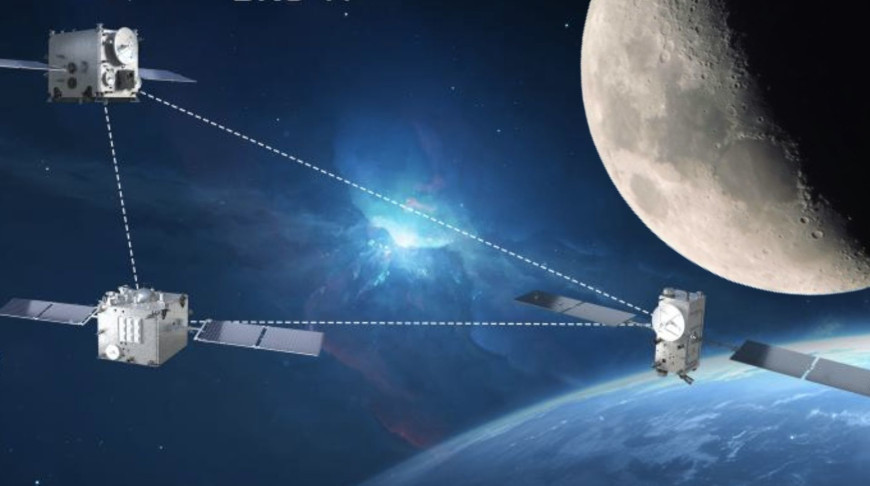
Photo: Interesting Engineering / iStock
BEIJING, 26 March (BelTA - Xinhua) - The Technology and Engineering
Center for Space Utilization (CSU) of the Chinese Academy of Sciences
(CAS) announced on Wednesday that the three-satellite constellation
based on the Distant Retrograde Orbit (DRO) in the Earth-moon space has
been operating in orbit for two years, providing a foundation for future
lunar exploration.
The announcement was made at the SciTech
Forum on the Development and Utilization of Earth-Moon Space, a
sub-forum of the 2026 Zhongguancun Forum (ZGC Forum), which kicked off
in Beijing on Wednesday.
This constellation project successfully
completed the world's first low-energy insertion into the DRO. DRO-A and
DRO-B, two satellites developed by the CAS and deployed in the DRO,
have established inter-satellite measurement and communication links
with DRO-L, a previously launched near-Earth orbit satellite.
The
DRO is a highly stable orbit located in the Earth-moon space, which
refers to the region extending outward from near-Earth and near-lunar
orbits to a distance of up to 2 million kilometers from Earth.
According
to the CSU, the project has verified stable residency and low-energy
maneuvering of spacecraft in the DRO. The project became the first to
tour all Lagrange points in the Earth-moon space in a single flight, and
its technologies are expected to play an important role in future lunar
exploration.
The forum brought together more than 200
representatives from over 20 institutions. Discussions focused on key
issues such as Earth-moon space infrastructure, low-cost access to the
Earth-moon space, and sustainable resource utilization.
Ding
Chibiao, vice president of the CAS, said the Earth-moon space is a
strategic hub connecting Earth to deep space and a new frontier for
scientific and industrial transformation.
Ding added that the CAS
will continue to strengthen cooperation with research institutions,
universities and companies to support China's goal of becoming a space
power.
Hou Junshu, deputy director of the Standing Committee of
the Beijing Municipal People's Congress, said in his speech that global
space activities are shifting from pure exploration to a balance of
exploration and utilization.
Hou noted that Beijing is home to
more than half of the country's core space research units and is
building itself into a hub for commercial aerospace innovation. He
called for stronger innovation, deeper integration between technology
and industry, and more open international cooperation.
The 2026
ZGC Forum, running in Beijing through Sunday, is focused on the theme of
"Full Integration Between Technological and Industrial Innovation."
Since its founding in 2007, this forum has become a major international
event for advancing science and technology innovation.