Partners
29 лістапада 2024, 12:34
China set to build next-generation BeiDou system
BEIJING, 29 November (BelTA - Xinhua) - China is planning to develop its
next-generation BeiDou system, which will be technologically more
advanced and functionally more powerful, and offer higher quality
services.
Three experimental satellites of this navigation system
are scheduled for launch around 2027, while network deployment will
begin by about 2029 and will be completed by 2035.
China is
targeting the achievement of critical technological advancements by
2025, as shown by a report released on Thursday at a symposium to mark
the 30th anniversary of the construction of the country's BeiDou
Navigation Satellite System (BDS).
The next-generation BeiDou
system will deliver real-time, highly accurate navigation, positioning
and timing with precision levels ranging from meters to decimeters,
according to the China Satellite Navigation Office.
It will be
characterized by precision and trustworthiness, seamless accessibility,
intelligent capabilities, networked integration and adaptable
flexibility, said Yang Changfeng, chief designer of the BDS.
Also, the system will provide comprehensive coverage to user terminals spanning from the Earth's surface to the depths of space.
The
Chinese-made BDS was initiated in 1994. The construction of BDS-1 and
BDS-2 was completed in 2000 and 2012, respectively. When BDS-3 was
completed and put into service on July 31, 2020, China became the third
country to have an independent global navigation satellite system.
The
hybrid orbital constellation of BDS stands out as a "Chinese solution"
compared to other global satellite navigation systems that utilize a
single orbital constellation configuration.
BDS-3 consists of 24
medium Earth orbit satellites, three geostationary Earth orbit
satellites and three inclined geosynchronous satellite orbit ones,
setting a new standard for global satellite navigation systems.
The
next-generation BDS will "optimize the constellation structure to form a
mixed constellation of high, medium and low Earth orbits," according to
Xie Jun, deputy chief designer of the BDS.
It will also feature
an integrated and efficient ground infrastructure, ensuring flexible
resource allocation, data sharing and uninterrupted operations.
The
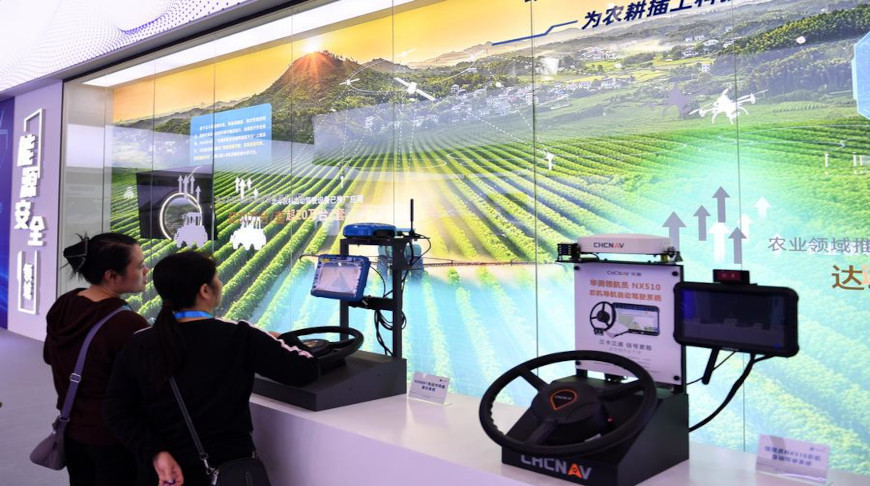
BDS services and related products have been exported to more than 130
countries, providing users with diversified choices and better
application experience, and promoting industrial development, according
to a bluebook released in October.