Partners
27 красавіка 2026, 10:09
China finds new moon mineral in first domestically recovered lunar meteorite
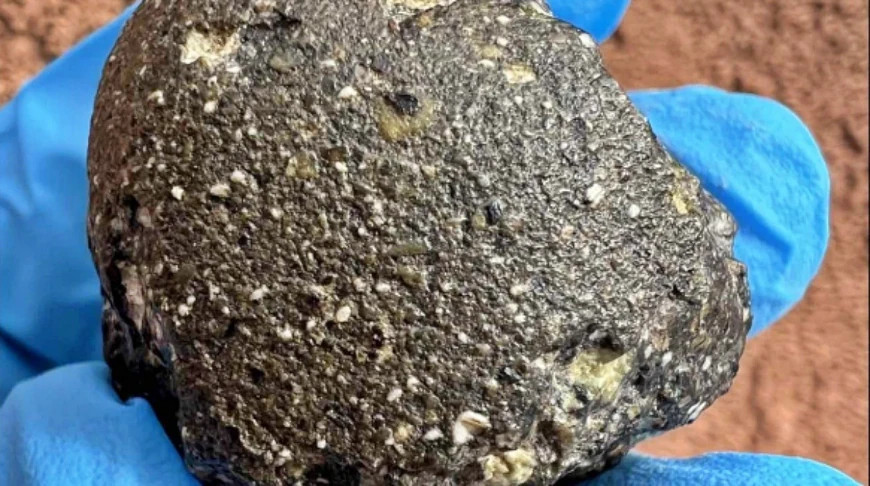
Photo: CMSA / iStock
BEIJING, 27 April (BelTA - China Daily) - Chinese scientists have
identified a new mineral in the first lunar meteorite ever found in
China, marking the 11th lunar mineral discovered worldwide. With this
finding, China has now identified four lunar minerals, tying with the
United States for the most lunar mineral discoveries.
The
mineral, named Magnesiochangesite-(Ce), has been approved by the
International Mineralogical Association's Commission on New Minerals,
Nomenclature and Classification, the global authority responsible for
verifying and naming newly discovered minerals.
A
rare-earth-bearing phosphate, Magnesiochangesite-(Ce) is colorless and
transparent with a glass-like luster. It is brittle, breaks with
shell-like fractures, and fluoresces under ultraviolet light.
Researchers said such properties help distinguish it from other lunar
materials.
The mineral was discovered in Pakepake 005, the first
lunar meteorite found in China. The 44-gram spherical stone, with a dark
fusion crust formed during its passage through Earth's atmosphere, was
recovered in 2024 in the Taklamakan Desert in Xinjiang Uygur autonomous
region.
Wang Yanjuan, a doctoral graduate at the Chinese Academy
of Geological Sciences and the first to identify the mineral, said the
discovery carries scientific significance.
"The discovery
provides key mineralogical evidence for understanding the origin and
evolution of the moon, and expands the boundaries of human knowledge of
the material world," Wang said.
She added that the mineral's
crystal structure and chemical composition offer insights into lunar
volcanic activity and the way rare-earth elements separate during
planetary formation. She also noted its unusual luminescent properties
could inform the development of new glowing materials.
Che
Xiaochao, an associate researcher at the Planetary Science Research
Center of the Institute of Geology under the Chinese Academy of
Geological Sciences, said analysis of the meteorite relied on a
domestically developed high-resolution secondary ion mass spectrometer.
The instrument uses a focused ion beam to analyze a sample's surface
composition at the microscopic level without dissolving or destroying
it.
"It's like doing a CT scan on the rock - without dissolving
the sample, we can accurately obtain its internal chemical information
and precisely analyze almost all elements and isotopes," Che said. He
noted the technology also has applications in semiconductors and new
energy materials.
Institute director Yang Zhiming said advanced instruments are essential for accurately measuring and analyzing rare samples.
He
added that the instrument was also used in studying lunar samples from
China's Chang'e 6 mission and the country's first lunar meteorite,
underscoring the importance of mastering core scientific equipment and
analytical techniques to advance research capabilities.