Partners
04 красавіка 2025, 10:14
China accelerates humanoid robot development for diverse applications
BEIJING, 4 April (BelTA - Xinhua) - At the Zhongguancun International
Innovation Center in Beijing, the humanoid robot Kuavo has become a
familiar sight, effortlessly handling reception duties, responding to
visitor inquiries, and guiding guests in finding their way through the
facility.
"Standing 1.7 meters tall with advanced cognitive
capabilities, Kuavo is our next-generation service robot," said Guo Da,
sales manager at Shenzhen-based Leju Robotics. "Currently deployed in
universities, exhibition halls and automotive plants, the model is set
to enter homes and offer services in the future."
The recently
concluded 2025 Zhongguancun Forum highlighted China's progress in
robotics, featuring nearly 100 humanoid models performing tasks ranging
from musical performances to event hosting.
Driven by rapid
advancement in embodied intelligence, China's humanoid robots are
evolving at an accelerated pace, extending their reach into both
industrial and household applications.
Industry data underscores
China's growing leadership in the relevant field. According to the
Ministry of Industry and Information Technology, the country holds over
190,000 active robotics patents, accounting for roughly two-thirds of
the global total.
According to the Chinese Institute of
Electronics, China's humanoid robot market is projected to reach 870
billion yuan (about 120 billion U.S. dollars) by 2030.
Several
advanced models are already entering commercial use. Developed by the
Beijing Innovation Center of Humanoid Robots, the Tiangong Ultra robot
is capable of running at 12 km per hour and climbing 35-cm steps, and is
preparing for an upcoming humanoid robot marathon.
Meanwhile,
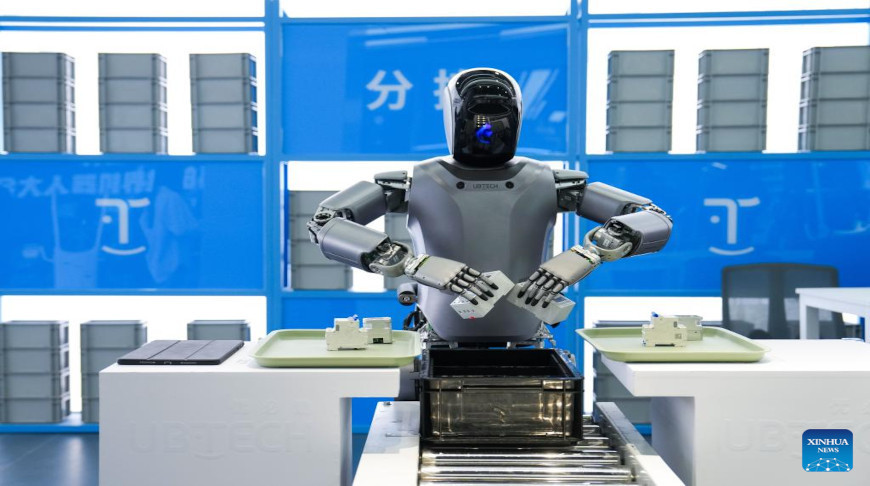
Walker S1, developed by the Shenzhen-based tech company UBTECH, is
undergoing precision quality inspections at an Audi production facility.
Government
support is further accelerating development. Beijing recently unveiled a
three-year action plan for embodied intelligence innovation and
industrial growth, backed by a 100-billion-yuan fund. Similar
initiatives are underway in Guangdong, Sichuan and Shanxi provinces.
Beijing
has identified embodied intelligence as a key focus for next-generation
AI development, now transitioning from research to commercialization,
said Su Guobin, deputy director of the Beijing Municipal Bureau of
Economy and Information Technology.
The development prospects of
the industry have been impressive. Leju Robotics Chairman Leng Xiaokun
noted that Kuavo received 250 orders in the first quarter, surpassing
the company's half-year target.
Unitree Robotics Vice General
Manager Wang Qizhou has emphasized efforts to boost production
efficiency while shifting from pre-trained to autonomous adaptive
systems.