Partners
25 чэрвеня 2025, 09:16
Archaeologists uncover rare library in Türkiye’s ancient city of Stratonikeia
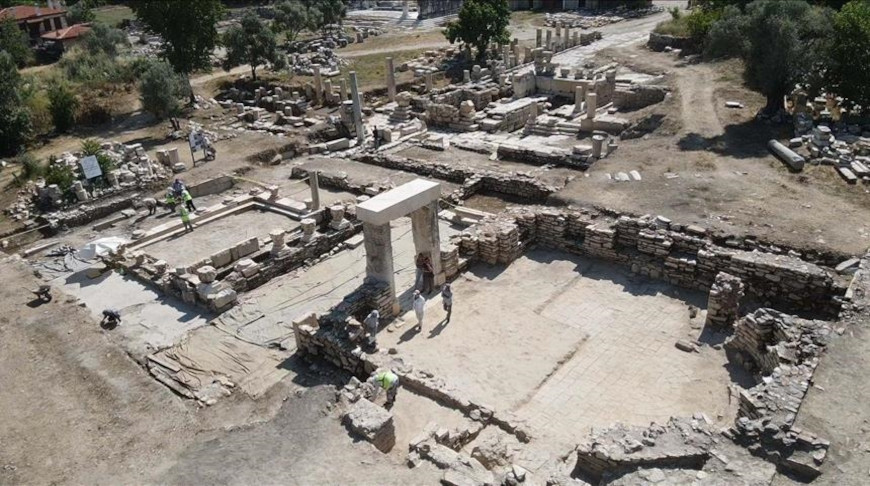
MUGLA / ISTANBUL, 25 June (BelTA - Anadolu) - Archaeologists are
uncovering and restoring a rare ancient library in Stratonikeia, one of
southwestern Türkiye’s most important cities of the Carians, a people
the Greek historian Herodotus wrote of in the fifth century BC.
Located
in Mugla and listed on UNESCO’s World Heritage Tentative List,
Stratonikeia is one of the world’s largest known marble cities and is
also known as the “City of Gladiators.” Excavations at the site have
been ongoing since 1977 and continue now year-round.
Speaking to
Anadolu, Pamukkale University archaeologist Bilal Sogut, head of the
Stratonikeia and Lagina excavation team, said the library is nestled at
the junction of four main streets in the city center.
Originally
built in the Hellenistic era after the death of Alexander the Great, the
site was redesigned during the Roman era - with mosaics added to the
structure - and remained in use into the fourth century AD, Sogut added.
Inscriptions
on the mosaics indicate the library was constructed by a master builder
from Ephesus, he noted, referring to a famed site along Turkiye’s
Aegean coast.
Sogut’s team has been excavating the site for
roughly five years. During this period, they have partially uncovered
the library’s entrance section, the connecting passage to South Street,
the surrounding porticoes, the courtyard, the main reading hall, and
several adjoining rooms, he said.
He said the building was
damaged in a powerful earthquake around 610 AD, which devastated the
city and led to the library being abandoned.
“We have identified
the full story of the structure – how it has changed since its
establishment, how it was restored after the earthquake, how people have
used it again, and how much importance people have attached to it in
every period,” he said.
“We have determined all the sections of
the ancient-era library to a certain extent. We also uncovered the
columns and superstructure elements belonging to the courtyard area. In
the upcoming period, by reconstructing a portion of these columns, we
want visitors to witness the grandeur of the ancient library.”
“Thanks
to the excavations, we made significant findings and realized that we
are in a magnificent library. Now we know its entire plan. We have also
determined that this plan differs from other known library plans in
Anatolia and that it served as an example for a library in North
Africa," he said.