Partners
21 лістапада 2025, 09:30
3rd-century mosaic floor with figurative motifs unearthed in northwestern Türkiye
BURSA, 21 November (BelTA - Anadolu) - Archaeologists in the Iznik
district of northwestern Türkiye have uncovered part of a 3rd-century
mosaic floor first detected during sewer construction in 2014, officials
said.
The discovery halted the original construction and led to
the expropriation of the site, allowing for proper archaeological
investigation. Excavations launched this year by the Iznik Museum
Directorate revealed a well-preserved mosaic believed to be part of a
hall belonging to either a Roman-era public building or an elite
residence.
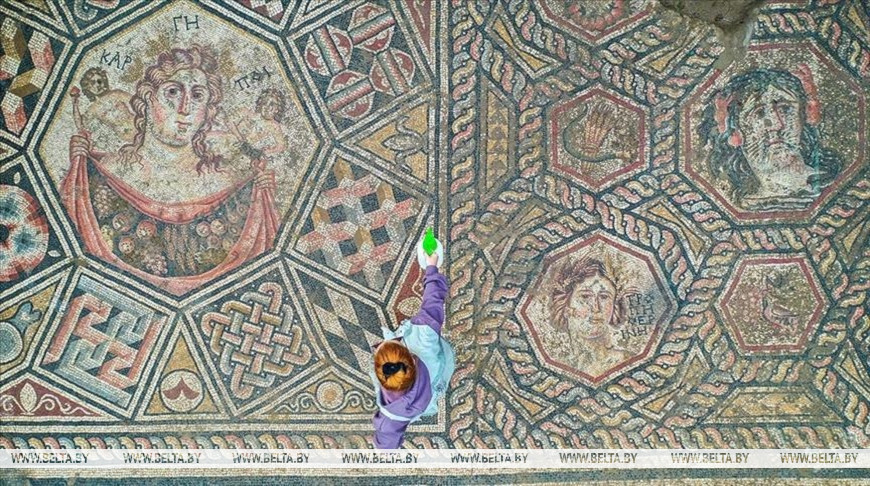
The floor features depictions including a woman
holding a basket of fruits, a female figure thought to represent Lake
Iznik and a range of geometric and three-dimensional motifs.
A border decorated with pomegranate and ivy leaves
Archaeologist
Yusuf Kahveci, a member of the excavation team, told Anadolu that the
mosaic was originally found to extend beneath the road and an adjacent
property, prompting the start of expropriation procedures.
He
said this year’s work uncovered the entire 50-square-meter mosaic within
the expropriated area, along with walls of the structure and upper
layers preserved above it. Chronology was determined through the
mosaic’s stylistic features, colors and motifs, as well as ceramics and
coins recovered at the site.
“We found that the main walls of the
building were once covered with wall paintings, and the floors were
paved with marble. However, both the frescoes and the marble floors were
damaged or removed over time. Much of the mosaic floor has survived
intact. In the preserved section, there are three different panels
surrounded by a border decorated with pomegranate and ivy leaves,” he
said.
Lake Iznik depicted as ancient female figure
Describing
the artwork, Kahveci said: “The left panel features a goddess of
abundance with mythological figures on either shoulder. There are
inscriptions with abbreviations above them, which will be better
understood after epigraphic analysis.”
“This is a very new find,
only a few weeks old. Scientific studies have not yet been conducted.
The central figure holds a basket of fruits, plants grown in Iznik
during that period. The surrounding geometric and three-dimensional
motifs show masterful craftsmanship,” he added.
He highlighted
the central figure: “We can read the name Askania beside the central
figure. This was the Roman-era name of Lake İznik. The mosaic depicts
the lake.”
“The figure is associated with water, with hair
rendered in algae-like detail, a crown made of crab claws, and waves
illustrated around her neck. In other words, Lake Iznik is personified
as an ancient woman,” he added.
Kahveci noted that the
surrounding braided motifs use 3–4 tones of each color and include
geometric and three-dimensional patterns such as labyrinths and Gordian
knots.
Although the exact function of the building remains
unclear, Kahveci said the structure may have been a state-built public
building, a wealthy Roman villa or even a bath complex, as only a small
part has been excavated.
He added that findings from the site
indicate continuous settlement from the 3rd century through the
15th–16th centuries and into the early Republican period.