Economy
02 красавіка 2026, 15:21
Belarus sees broad opportunities for energy cooperation with Russia
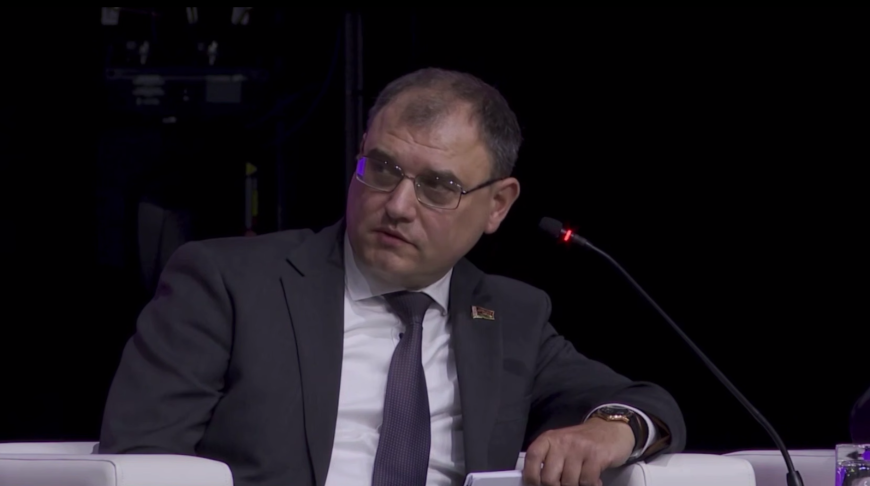
Screenshot of the video of the press service of Belarus' Government
MINSK, 2 April (BelTA) – Belarus’ Deputy Prime Minister Viktor Karankevich outlined how cooperation between Belarus and Russia in the energy sector will develop, speaking at the plenary session GOELRO ver. 2.0: Revival of a Legend, during the Kazan International Energy Forum ENERGOPROM, BelTA learned from the government press service.
Viktor Karankevich noted that there are many points of convergence between Belarus and Russia in the energy sector. “First, this includes the implementation of import-substitution projects and the development of new, in-demand types of generating and power-grid equipment. Second, the acquisition of new competencies in equipment servicing, the ability to replace imported spare parts with domestically produced ones, including through re-engineering and additive technologies. Most importantly, large-scale joint work has been carried out within the creation of the Union State’s unified electricity market. Rules, electricity trading mechanisms, the composition of market participants, and approaches to organizing a unified technological process for operational and dispatch control have all been defined,” the deputy prime minister said.
According to him, the formation of a unified electricity market is aimed primarily at harmonizing economic conditions and creating an equal competitive environment, whose functioning will ensure a wider range of price options for electricity consumers. An unquestionable advantage of the market will be increased reliability of power systems due to additional investments in the modernization of the power-grid complex and the renewal of generating capacities. “All these issues are extremely relevant for our countries, given the existing external challenges,” Viktor Karankevich added.
He emphasized that for Belarusian industrial enterprises, further development and increased competitiveness will be inseparable from the introduction of robotics and the automation of technological and production processes. This will require the creation of data centers and the processing of large volumes of data. Meeting these needs will also require a significant increase in electricity consumption.
“We are focusing on improving the management quality of the power-grid complex, creating energy storage systems, introducing smart grids, and further modernizing both generating and grid equipment. Over the next five years, under the state program, we plan to build and reconstruct more than 18,500 km of power transmission lines of various voltage classes and over 100 backbone substations of 110-330 kV. This will create a solid foundation for electricity consumption growth to meet the needs of the real sector and the population,” the deputy prime minister said.